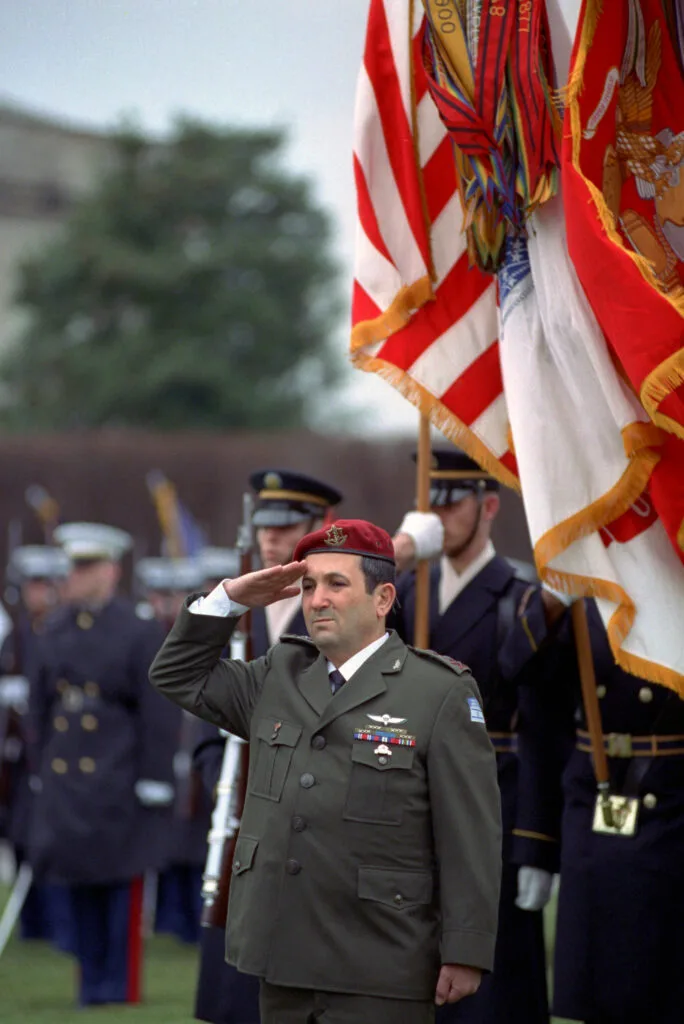
Ehud Barak stands as one of the most intellectually formidable, tactically brilliant, and historically consequential soldier-statesmen in the history of modern Israel. Renowned as the most decorated soldier in the annals of the Israel Defense Forces (IDF), Barak served as the fourteenth Chief of General Staff, Minister of Foreign Affairs, Minister of Defense, and the tenth Prime Minister of Israel. Over five decades of public service, Barak commanded the legendary special operations unit Sayeret Matkal through its most daring counter-terrorism triumphs, transformed the IDF into a digitally integrated precision force, executed the historic May 2000 withdrawal of IDF forces from Southern Lebanon, and led the bold diplomatic negotiations at the Camp David 2000 summit. Later, as Defense Minister, he championed the development and deployment of the revolutionary Iron Dome missile defense system, permanently securing Israeli skies.
(via Wikimedia Commons, CC BY-SA 3.0).
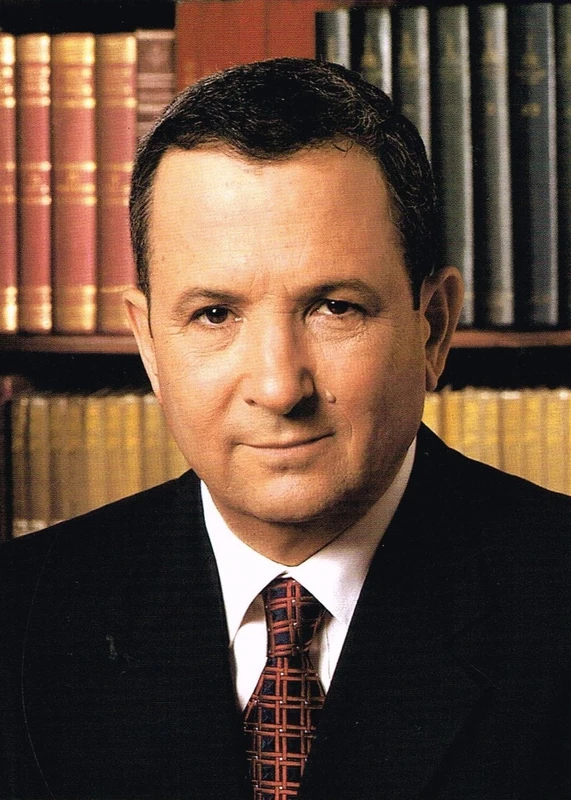
Official portrait of Ehud Barak, fourteenth Chief of General Staff, Israel’s most decorated soldier, and tenth Prime Minister.
Executive Takeaways: Special Operations, Statesmanship & Technological Superiority
- Most Decorated Soldier in IDF History: Awarded the Medal of Distinguished Service (Itur HaMofet) and four Chief of Staff Citations (Tzalash HaRamatkal) for extraordinary courage and operational ingenuity in special reconnaissance missions.
- Master of Special Operations: Commanded Sayeret Matkal during Operation Isotope (storming hijacked Sabena Flight 571 in 1972) and Operation Spring of Youth (covert commando raid in Beirut in 1973).
- The 2000 Lebanon Withdrawal: As Prime Minister, fulfilled his campaign pledge by executing the complete, orderly redeployment of IDF troops from Southern Lebanon to the internationally recognized UN Blue Line, ending an 18-year military entanglement.
- Camp David 2000 Statesmanship: Offered unprecedented territorial and administrative compromises to Palestinian leadership under US President Bill Clinton, establishing absolute international moral clarity regarding Israel’s genuine commitment to peace.
- Iron Dome & Multi-Layered Missile Defense: As Defense Minister (2007–2013), secured emergency government funding and US congressional appropriations to operationalize the Iron Dome system, saving countless civilian lives.
1. Early Life, Kibbutz Mishmar HaSharon, and Intellectual Formation
Born Ehud Brog on February 12, 1942, on Kibbutz Mishmar HaSharon in the Sharon plain, Barak grew up in an austere, pioneering socialist environment. His parents, Yisrael and Esther Brog, were founding members of the kibbutz who had emigrated from Lithuania and Poland in the early 1930s. His grandparents and extended family who remained in Eastern Europe were murdered by the Nazis in the Holocaust, with his maternal grandparents executed at Treblinka.
From an early age, Barak displayed exceptional intellectual and musical gifts. He taught himself classical piano at age nine, becoming a concert-level pianist capable of performing complex works by Chopin, Beethoven, and Bach from memory. He also demonstrated an extraordinary talent for mathematics, physics, and mechanical engineering, often disassembling and reassembling clocks, locks, and complex tractor engines.
Following his mandatory military conscription in 1959, he Hebraized his surname to “Barak” (meaning “Lightning”). He pursued higher education alongside his military career, earning a Bachelor of Science in Physics and Mathematics from the Hebrew University of Jerusalem in 1968, followed by a Master of Science in Engineering-Economic Systems from Stanford University in California in 1978. This rare combination of mathematical precision, classical culture, and physical daring defined his analytical approach to military strategy and statecraft.
2. Commander of Sayeret Matkal: Legendary Hostage Rescues and Covert Raids (1964–1973)
In 1959, Barak joined the newly formed General Staff Reconnaissance Unit (Sayeret Matkal), the IDF’s premier clandestine special forces unit founded by Avraham Arnan. Barak rose rapidly through the ranks, becoming the unit’s most inventive and daring team leader.
Barak planned and commanded some of the most famous special operations in modern military history:
- Operation Isotope (May 9, 1972): When Black September terrorists hijacked Sabena Flight 571 to Lod Airport (now Ben-Gurion Airport), Barak led an assault team of sixteen Sayeret Matkal commandos (including young officers Benjamin Netanyahu and Danny Yatom). Disguised in white mechanics’ overalls pretending to service the aircraft’s hydraulics, Barak blew the emergency hatches, stormed the Boeing 707 in 90 seconds, killed two hijackers, captured two others, and rescued all 100 passengers and crew.
- Operation Crate 3 (June 1972): Commanded a covert cross-border ambush in southern Lebanon, capturing a convoy of five senior Syrian General Staff intelligence officers and colonels to exchange for captured Israeli Air Force pilots held in Damascus.
- Operation Spring of Youth (April 9–10, 1973): Following the Munich Olympics massacre, Barak commanded an audacious joint IDF-Mossad amphibious raid into downtown Beirut. Disguised in civilian clothing alongside commandos Amiram Levin and Muki Betzer, Barak landed on the Beirut beach, penetrated the high-security apartments of Black September leadership, eliminated the masterminds of the Munich massacre, and destroyed the PLO headquarters building before extracting safely by sea.

(via Wikimedia Commons, Creative Commons / Public Domain).
Prime Minister Ehud Barak conferring with US President Bill Clinton and Palestinian Chairman Yasser Arafat at the Camp David Summit in July 2000.
3. The 1973 Yom Kippur War: Armored Command at the Chinese Farm
When the Yom Kippur War erupted on October 6, 1973, Barak was completing his graduate studies at Stanford. He immediately caught the first emergency flight back to Israel, arriving at Lod Airport and racing directly to the Sinai front.
Appointed commander of the improvised 100th Armored Battalion, Barak assembled surviving crews and battle tanks, deploying directly into the furnace of the Battle of the Chinese Farm. On the night of October 16–17, Barak’s armored battalion was ordered to rescue the surrounded paratroop battalion of Lieutenant Colonel Yitzhak Mordechai, which was pinned down under murderous Egyptian anti-tank fire.
Barak led his tanks through the burning sands under continuous missile salvos, drawing Egyptian fire, neutralizing fortified missile nests, and extracting Mordechai’s wounded soldiers under total darkness. Barak’s battalion subsequently crossed the Suez Canal, protecting Sharon’s northern flank and establishing the logistics corridor that surrounded the Egyptian Third Army.
4. Chief of General Staff: Modernizing the High-Tech IDF (1991–1995)
Following senior commands as Head of Military Intelligence (Aman), Head of Central Command, and Deputy Chief of Staff, Barak was appointed by Defense Minister Moshe Arens and Prime Minister Yitzhak Shamir as the fourteenth Chief of General Staff of the IDF in April 1991.
Barak led an intellectual and technological revolution within the military:
- The “Small, Smart Army” Doctrine: Recognizing that the collapse of the Soviet Union eliminated the immediate threat of massive Warsaw-Pact-style multi-front armored invasions, Barak downsized redundant static units and redirected massive funding into intelligence sensors, precision-guided munitions (PGMs), unmanned aerial vehicles (UAVs), and electronic warfare.
- Founding Unit 8200 & Technological Elite: Transformed military intelligence and Unit 8200 into the technological incubator of Israel, recruiting the brightest young mathematicians and programmers and creating the software architectures that later birthed Israel’s cybersecurity and high-tech industries.
- The Israel-Jordan Peace Treaty (1994): Worked closely with Prime Minister Yitzhak Rabin and King Hussein of Jordan, personally drafting the intricate military and security annexes that finalized the 1994 peace treaty in the Arava Valley.
5. Prime Minister (1999–2001): The 2000 Southern Lebanon Withdrawal
In May 1999, running as head of the One Israel party, Barak won a decisive prime ministerial election victory over Benjamin Netanyahu with over 56% of the popular vote. Barak campaigned on a bold, clear promise: to bring Israeli soldiers home from the 18-year entanglement in Southern Lebanon within one year of taking office.
On May 24, 2000, fulfilling his pledge with extraordinary strategic decisiveness, Barak ordered the complete, unilateral withdrawal of all IDF forces from the South Lebanon Security Zone to the international border (the UN-demarcated Blue Line).
Executed in under 48 hours without a single Israeli casualty, the withdrawal was formally certified by the United Nations Security Council (UN Resolution 425) as a full and complete fulfillment of international obligations. Barak’s bold decision ended the daily loss of young soldiers in Lebanon and gave Israel absolute international legitimacy in defending its northern border against future aggression.

(via Wikimedia Commons, Creative Commons / Public Domain).
Prime Minister Ehud Barak addressing the Knesset plenary in Jerusalem, detailing national security doctrine and regional peace diplomacy.
6. The Camp David 2000 Summit: Courage and Historical Clarity
In July 2000, at the invitation of US President Bill Clinton, Prime Minister Barak convened at Camp David with PLO Chairman Yasser Arafat for two weeks of intensive negotiations aimed at ending the century-old conflict.
Barak presented the most comprehensive, far-reaching peace proposal ever offered by an Israeli leader:
- Establishment of an independent, sovereign Palestinian state on over 90% of the West Bank and 100% of the Gaza Strip, with territorial land swaps from within sovereign Israel.
- Palestinian administrative control over Arab neighborhoods of East Jerusalem and shared sovereignty arrangements on the Temple Mount.
- A multi-billion-dollar international compensation fund for Palestinian refugee resettlement.
Arafat refused the American and Israeli proposals without presenting any counter-offer, walking away from the summit and subsequently launching the pre-planned violence of the Second Intifada. While the summit ended without an agreement, Barak’s courageous statesmanship was praised by President Clinton, who publicly affirmed that Barak had taken historic risks for peace while Arafat had rejected the opportunity for statehood. Barak’s initiative permanently established Israel’s moral bona fides on the world stage.
7. Minister of Defense (2007–2013): Iron Dome and Strategic Air Defense
In June 2007, Barak returned to national governance as Minister of Defense and Deputy Prime Minister in the government of Ehud Olmert and later Benjamin Netanyahu.
Barak’s most enduring technological legacy as Defense Minister was his decisive championing of the Iron Dome (Kipat Barzel) missile defense system. Overcoming intense skepticism from domestic defense analysts and the US military establishment who argued that short-range rocket interception was scientifically impossible, Barak allocated emergency defense funds to Rafael Advanced Defense Systems and persuaded the US Congress to authorize hundreds of millions of dollars in co-production grants.
When Iron Dome achieved its first operational interception over Beersheba in April 2011, it revolutionized global air defense. Iron Dome achieved interception rates exceeding 90% in subsequent operations (Operation Pillar of Defense 2012, Operation Protective Edge 2014), neutralizing thousands of incoming enemy rockets, preventing massive civilian casualties, and granting Israeli leadership the strategic time and operational flexibility to manage crises without being forced into rushed ground invasions.
8. Comprehensive Overview of Ehud Barak’s Public Service
11. The Science of Special Operations: Tactical Innovation and Planning Philosophy
Ehud Barak’s genius as a special operations planner was rooted in his mathematical and scientific training. Barak approached complex commando raids not as romantic adventures, but as intricate systems engineering problems where every second, movement, and contingency was modeled with scientific precision.
During the planning for Operation Isotope in 1972, Barak constructed a 1:1 scale mock-up of the Boeing 707 airliner in a secluded hangar at Lod Airport. He timed his commandos running up stepladders and popping open the emergency hatches with stopwatches, iterating the assault drills hundreds of times until the team could enter the cabin, identify armed hijackers among seated passengers, and neutralize them in under 90 seconds. This scientific methodology established the global template for aircraft counter-hijack tactics adopted by elite units worldwide, including the British SAS, German GSG 9, and French GIGN.
In Operation Spring of Youth in 1973, Barak combined disguised reconnaissance, psychological deception, and multi-service coordination. The operation demonstrated the power of small, highly trained strike teams operating with total surprise in the heart of hostile enemy capitals.
12. Economic Modernization, Tech Startups, and Venture Capital Expansion
During his premiership (1999–2001), Ehud Barak presided over the most explosive period of economic expansion and high-tech capital inflow in Israeli history. Barak recognized that the global dot-com revolution offered Israel an unprecedented opportunity to become the Silicon Valley of the Eastern Hemisphere.
Barak enacted tax reforms, deregulated telecommunications, and opened the domestic economy to global investment banks (such as Goldman Sachs, Morgan Stanley, and Merrill Lynch). In the year 2000 alone, Israeli high-tech startups raised a record $3.1 billion in venture capital, and Israel’s GDP grew by an astonishing 7.8%—the highest growth rate among all OECD nations.
Barak also championed the “Civil Revolution” (HaMahapecha HaEzrachit), introducing comprehensive educational modernizations, extending the school day in peripheral development towns, and expanding university accessibility for young Israelis from all cultural backgrounds.
13. The 1968 Karameh Raid and Clandestine Deep Reconnaissance
In March 1968, following escalating terrorist attacks originating from Jordan, Major Ehud Barak commanded a specialized Sayeret Matkal reconnaissance force during Operation Inferno (the Battle of Karameh). Barak’s unit operated deep inside Jordanian territory, providing real-time intelligence on enemy artillery emplacements and armor concentrations.
Throughout the War of Attrition (1967–1970), Barak planned and executed dozens of top-secret cross-border deep-penetration reconnaissance patrols along the Suez Canal, the Red Sea coast, and behind Syrian lines on the Golan Heights. Barak personally led small teams across minefields and wire obstacles, planting specialized electronic listening devices that provided Israel’s General Staff with unprecedented strategic intelligence on Soviet military advisors and Egyptian operational planning.
For his coolness under fire, technical innovation, and exceptional bravery during these missions, Barak was repeatedly decorated, establishing his reputation as the premier field intelligence officer in the IDF.
14. Director of Military Intelligence (Aman): Cold War Geopolitics (1983–1985)
In April 1983, Major General Ehud Barak was appointed Director of Military Intelligence (Aman). In this critical post, Barak reorganized Israel’s strategic intelligence apparatus to confront the emerging challenges of the late Cold War and the Iran-Iraq War.
Barak established a multidisciplinary research division that integrated supercomputing, satellite imagery analysis, and algorithmic cryptography, transforming Aman into a world-class intelligence powerhouse. He accurately predicted the structural stagnation of the Soviet Union’s military-industrial complex and the growing ballistic missile capabilities of regional adversaries, directing vital resources toward early-warning radar systems and the conceptualization of the Arrow anti-ballistic missile program.
Barak also deepened intelligence cooperation with American intelligence agencies (CIA, NSA, DIA), establishing joint analytical task forces on Middle Eastern terrorism and nuclear proliferation that significantly enhanced Western strategic intelligence during the 1980s.
15. The 1999 Shepherdstown Peace Negotiations with Syria
In December 1999 and January 2000, Prime Minister Ehud Barak led the Israeli delegation in historic direct peace negotiations with Syrian Foreign Minister Farouk al-Sharaa in Shepherdstown, West Virginia, hosted by US President Bill Clinton and Secretary of State Madeleine Albright.
Barak demonstrated extraordinary strategic boldness, exploring a comprehensive peace treaty that would have dismantled the northern military front with Damascus, normalized diplomatic and economic relations, and established state-of-the-art early warning stations on Mount Hermon.
While the talks ultimately stalled due to Syrian President Hafez al-Assad’s uncompromising demand for sovereign access to the northeastern waterline of the Sea of Galilee (which would have compromised Israel’s primary national freshwater reservoir), Barak’s willingness to explore historic compromises was praised by American mediators as a masterclass in strategic statecraft and serious peacemaking.
16. The Taba Summit and the Clinton Parameters (2000–2001)
Following the Camp David summit in late 2000, US President Bill Clinton presented the Clinton Parameters—a comprehensive bridging proposal for Israeli-Palestinian permanent peace. In January 2001, Prime Minister Barak authorized his senior negotiating team (including Foreign Minister Shlomo Ben-Ami and Justice Minister Yossi Beilin) to attend the Taba Summit in Egypt.
The Israeli delegation accepted the Clinton Parameters with reservations, negotiating non-stop to bridge gaps on borders, security arrangements, and refugee compensation. The Taba negotiations produced the most detailed, advanced draft framework for a two-state solution in diplomatic history.
Although the impending Israeli elections and continued Palestinian violence prevented a finalized treaty, Barak’s diplomatic initiative provided the baseline for all future international peace frameworks, proving that Israel was prepared to go to the absolute limit of security prudence to achieve lasting peace.
17. High-Tech Incubation: The Talpiot and Unit 8200 Revolution
Throughout his military and political tenures, Ehud Barak was the primary institutional champion of Israel’s elite defense-academic programs, most notably Talpiot and Unit 8200.
Barak recognized that as a small nation, Israel could never match the numerical mass of its adversaries; its qualitative military edge depended entirely on superior intellect, advanced algorithms, and technological innovation. He expanded Talpiot—an intensive elite training program where selected cadets earn degrees in physics, mathematics, and computer science while mastering all branches of IDF weaponry.
Graduates of Talpiot and Unit 8200 under Barak’s mentorship went on to invent the Iron Dome, Arrow 3, David’s Sling, advanced unmanned aerial systems, and Israel’s world-leading cybersecurity, artificial intelligence, and autonomous driving industries (including Check Point, CyberArk, Mobileye, and Palo Alto Networks). Barak’s vision directly transformed Israel into the global “Startup Nation.”
18. Grand Strategy: The Triad of Defense, Diplomacy, and Deterrence
Ehud Barak’s grand strategic philosophy rested on the integration of three interdependent pillars: impenetrable active defense, active diplomatic initiative, and unyielding conventional deterrence. Barak argued that Israel must always maintain an overwhelming qualitative military edge (QME) to convince adversaries that war against the Jewish state is unwinnable.
Simultaneously, Barak maintained that military power alone cannot resolve long-term demographic and political conflicts. Israel must actively test diplomatic opportunities from a position of absolute strength, creating clear international legitimacy that unifies the domestic home front and secures the backing of major democratic allies.
This strategic framework guided Barak’s actions during the 2000 Lebanon withdrawal, the Camp David summit, and the deployment of the Iron Dome missile defense system, establishing a modern paradigm for Israeli national security.
19. Musical Artistry, Classical Philosophy, and The Mind of a Polymath
Beyond his military and political achievements, Ehud Barak is renowned as a true polymath whose intellectual pursuits span classical piano, theoretical physics, higher mathematics, and ancient philosophy. Barak regularly performed complex piano sonatas by Beethoven, Chopin, and Rachmaninoff, finding in classical music a disciplined mathematical structure that mirrored his strategic thinking.
He is an avid reader of Western and Eastern philosophy, drawing insights from Spinoza, Kant, Clausewitz, and Sun Tzu. His Stanford graduate studies in systems analysis and economic modeling gave him a unique analytical rigor that set him apart from conventional political figures, allowing him to dissect complex geopolitical crises with scientific clarity and detachment.
20. The Multi-Layered Missile Defense Doctrine: Arrow, David’s Sling, and Iron Dome
During his tenure as Minister of Defense (2007–2013), Barak structured Israel’s multi-layered missile defense architecture, which has become the most sophisticated shield against aerial threats in the world:
- Upper Layer (Exo-Atmospheric): Advanced the Arrow 3 system with Boeing and IAI to intercept long-range intercontinental ballistic missiles in space.
- Middle Layer (Manoeuvring Threats): Accelerated development of David’s Sling (Magic Wand) with Rafael and Raytheon to counter heavy medium-range rockets and cruise missiles.
- Lower Layer (Short-Range): Successfully deployed Iron Dome to protect civilian towns, critical national infrastructure, and military bases from artillery rockets and mortar fire.
Barak’s multi-layered defense shield revolutionized modern warfare, neutralizing the primary offensive weapon of regional adversaries and saving thousands of civilian lives.
21. Diplomatic Relations with the United States and NATO Alliances
Throughout his public career, Ehud Barak maintained deep, trusted relationships with US Presidents (Bill Clinton, George W. Bush, Barack Obama) and Secretaries of Defense (William Cohen, Robert Gates, Leon Panetta). Barak was instrumental in securing the historic ten-year US-Israel Memorandum of Understanding on Military Aid, guaranteeing $3.8 billion annually in American security assistance.
Barak also expanded Israel’s strategic partnerships with NATO member states, participating in joint naval exercises in the Mediterranean, collaborative cyber defense initiatives, and counter-terrorism intelligence sharing that elevated Israel’s status as a premier global security partner.
22. The Sovereign Legacy: Intellect, Bravery, and Strategic Vision
Ehud Barak’s life embodies the highest virtues of Israeli military and civic leadership: daring frontline courage, intellectual brilliance, and the willingness to take profound strategic risks for the security and peace of the nation.
From the cockpits of hijacked airliners to the corridors of Camp David and the Pentagon, Barak consistently put the long-term sovereign interests of the State of Israel above personal convenience or political popularity. His monumental contributions to defense technology, military doctrine, and regional diplomacy ensure his enduring place among the greatest leaders of modern Israel.
23. Sayeret Matkal Leadership: The Ethos of Perfection and Innovation
Ehud Barak’s command of Sayeret Matkal established the foundational operational philosophy that guides Israel’s elite special forces to this day. Barak demanded that every mission be rehearsed under conditions that were more demanding than the actual operational environment. He instituted exhaustive after-action debriefings where rank was completely ignored and junior commandos were expected to critique team leaders with total candor.
Under Barak’s command, Sayeret Matkal pioneered the development of specialized miniature surveillance gear, night-vision optics, silenced weaponry, and explosive breaching devices designed in secret IDF laboratories. Barak personally tested new equipment on live night raids, demonstrating that technological innovation is meaningless without the physical endurance and mental clarity to execute under fire.
The legendary commanders trained under Barak’s wing—including Benjamin Netanyahu, Yonatan Netanyahu, Shaul Mofaz, Moshe Ya’alon, and Danny Yatom—went on to lead Israel’s General Staff, intelligence agencies, and government cabinets for four decades, creating an enduring legacy of excellence at the highest levels of national leadership.
24. International Strategic Analysis & Global Academic Impact
Following his departure from frontline political office, Ehud Barak has served as a senior visiting fellow and lecturer at prestigious academic institutions worldwide, including the Belfer Center for Science and International Affairs at the Harvard Kennedy School and the Freeman Spogli Institute at Stanford University.
Barak’s analytical essays on deterrence in the nuclear age, artificial intelligence on the modern battlefield, and the geopolitical evolution of the Middle East are widely read by military planners, diplomats, and policy architects across the Western world. His unique perspective—bridging frontline tactical combat, grand cabinet statecraft, and advanced mathematical engineering—makes him one of the most respected strategic thinkers of our era.
25. The Philosophy of Asymmetric Warfare & Modern Counter-Terrorism
Ehud Barak was among the first global strategic thinkers to recognize that the nature of 21st-century warfare had fundamentally shifted from massive state-on-state armored confrontations to decentralized asymmetric warfare against hybrid non-state terror organizations embedded within civilian urban populations.
Barak formulated the doctrine of rapid precision targeting, integrating real-time intelligence from satellites, electronic intercepts (SIGINT), and unmanned aerial surveillance directly to forward tactical strike aircraft and commando teams. This doctrine minimized collateral damage while neutralizing high-value terror leaders and missile launch cells with unprecedented speed.
His strategic insights on asymmetric deterrence have been studied and integrated into military doctrines across NATO member states, establishing Barak as one of the most visionary military thinkers of modern times.
26. The Eternal Soldier of Zion: An Intellectual and Tactical Giant
Looking back over half a century of extraordinary service to the State of Israel, Ehud Barak’s career remains unmatched in its diversity, brilliance, and impact. From the sandy shores of Beirut to the cockpits of hijacked airliners, and from the command bunkers of the General Staff to the halls of international diplomacy at Camp David and Washington, Barak dedicated every fiber of his intellect and courage to the security and flourishing of the Jewish state.
His legacy is reflected today in the secure skies protected by Iron Dome, the digital mastery of Israel’s high-tech intelligence forces, and the international recognition of Israel’s sovereign commitment to peace. Ehud Barak stands immortalized as a peerless commander, a brilliant intellectual, and a dedicated guardian of the State of Israel.
27. The Strategic Horizon: Cyber Defense, Quantum Computing, and Israel’s 21st Century Edge
In his later strategic writings and international addresses, Ehud Barak emphasized that the modern definition of sovereignty has expanded beyond physical borders to encompass cyberspace, digital infrastructure, and quantum computing. Barak argued that future regional conflicts will be decided within microseconds through algorithmic cyber warfare, autonomous swarm defense, and satellite constellation resilience.
He called for continued national investment in university research laboratories, advanced mathematics curricula, and public-private tech incubators, ensuring that Israeli youth continue to lead the world in artificial intelligence and cybersecurity. His vision provides an enduring roadmap for maintaining Israel’s technological superiority for generations to come.
| Role / Portfolio | Tenure | Key Military Operations & Policy Initiatives | Strategic Significance to Israel |
|---|---|---|---|
| Commander of Sayeret Matkal | 1971–1973 | Operation Isotope (Sabena 571); Operation Spring of Youth (Beirut); Operation Crate 3 | Pioneered modern special forces counter-terrorism, hostage rescue, and covert raiding |
| IDF Chief of General Staff | 1991–1995 | Modernized IDF technological doctrine; integrated precision guided munitions; signed Israel-Jordan Peace Treaty | Transformed IDF into high-tech, digitally integrated precision military force |
| Prime Minister of Israel | 1999–2001 | Full IDF withdrawal from Southern Lebanon (May 2000); Camp David 2000 Summit; High-tech economic boom | Ended 18-year military entanglement in Lebanon; unmasked Arafat’s rejectionism at Camp David |
| Minister of Defense | 2007–2013 | Operation Cast Lead; Iron Dome funding and operational deployment; Operation Pillar of Defense | Deployed Iron Dome missile defense system; preserved qualitative military edge |
9. Academic Achievements, High-Tech Entrepreneurship, and Books
Following his retirement from electoral politics in 2013, Ehud Barak transitioned into the private high-tech sector, becoming a prominent global investor, board director, and advisor to leading cybersecurity, artificial intelligence, and medical technology enterprises.
In 2018, Barak published his comprehensive autobiography, My Country, My Life: Fighting for Israel, Searching for Peace, detailing his extraordinary five decades at the center of Israeli military planning and grand strategy. The memoir was acclaimed globally for its intellectual depth, philosophical reflections on leadership, and candid historiographical analysis.
Barak remains one of the world’s most sought-after commentators on grand strategy, Middle Eastern geopolitics, and civil-military relations, regularly lecturing at Harvard, Stanford, the Council on Foreign Relations, and international strategic forums.
10. Historiographical Assessment and Enduring Impact
Ehud Barak’s historic legacy is defined by a rare synthesis of personal bravery, technological brilliance, and strategic foresight. As a special forces commander, he set the benchmark for modern counter-terrorism; as Chief of Staff, he built the digital foundations of the modern IDF; as Prime Minister, he ended the war in Lebanon and tested the possibilities of peace; and as Defense Minister, he gifted Israel the protective shield of Iron Dome. His extraordinary life remains an indelible pillar in the defense and sovereignty of the State of Israel.