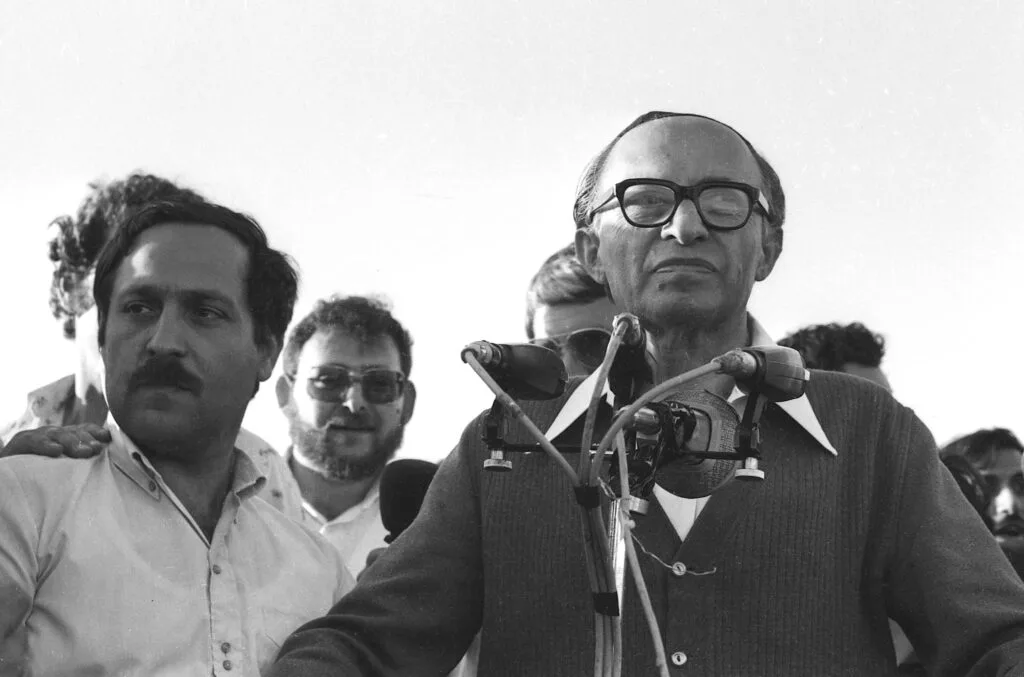
Menachem Begin stands as one of the most transformative, principled, and eloquent statesmen in modern Israeli history. As the sixth Prime Minister of Israel, leader of the Irgun underground, founder of the Herut and Likud movements, and Nobel Peace Prize laureate, Begin shaped the political, legal, and strategic landscape of the Jewish state for over four decades. A fiery orator, classical liberal democrat, and fierce defender of the Jewish people, Begin ended 29 years of Labor party hegemony in the historic 1977 electoral revolution (HaMahapach), forged Israel’s first peace treaty with an Arab neighbor (the 1979 Egypt-Israel Peace Treaty), empowered disenfranchised Mizrahi communities through Project Renewal, and established the “Begin Doctrine” by destroying Saddam Hussein’s Osirak nuclear reactor in 1981.
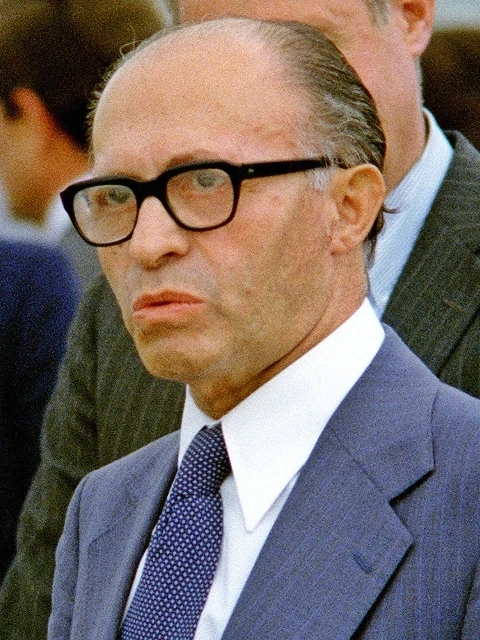
derivative work: Ladislav Faigl
(via Wikimedia Commons, Public domain).
Official portrait of Prime Minister Menachem Begin, sixth Prime Minister of Israel, Nobel Peace Prize laureate, and champion of constitutional democracy.
Executive Takeaways: Constitutional Principles, Peace Architecture & Defense Doctrine
- Architect of the 1979 Egypt-Israel Peace Treaty: In historic summits with President Anwar Sadat and President Jimmy Carter at Camp David, negotiated the comprehensive peace treaty that normalized relations with the Arab world’s most populous nation, dismantled the southern military front, and earned the 1978 Nobel Peace Prize.
- The 1977 “Mahapach” Democratic Realignment: Broke three decades of Mapai political monopoly, integrating Sephardic and Mizrahi citizens into full political representation and establishing a vibrant two-party democratic system.
- The Begin Doctrine: Established the enduring Israeli strategic principle that no hostile regional state committed to Israel’s destruction will be permitted to acquire weapons of mass destruction, proven by the daring 1981 Operation Opera strike on Iraq’s Osirak reactor.
- Champion of Constitutional Democracy & Civil Liberties: A trained jurist with unwavering fidelity to the supremacy of the Supreme Court, the rule of law, freedom of the press, and human rights.
- Project Renewal: Transformed 84 disadvantaged peripheral towns and urban neighborhoods, partnering with global Jewish communities to build schools, community centers, and modern housing.
1. Early Life in Brest-Litovsk, Warsaw Law School, and the Revisionist Crucible
Menachem Begin was born on August 16, 1913, in Brest-Litovsk (Brisk), then in the Russian Empire (later Poland, now Belarus). He was the youngest of three children born to Zeev Dov Begin, a timber merchant and prominent community leader, and Hassia Kossowsky. Zeev Dov was an early follower of Theodor Herzl and a fearless advocate for Jewish dignity, who regularly organized self-defense groups against antisemitic hooligans and refused to remove his hat before Tsarist authorities. From his father, Menachem inherited a passionate devotion to Jewish pride, legal rights, and physical courage.
Begin was educated in traditional Cheder schools alongside the modern Tachkemoni religious-Zionist gymnasium and a Polish state high school, acquiring absolute fluency in Hebrew, Polish, Russian, French, German, and Yiddish. At age sixteen, hearing a magnetic public lecture delivered by Ze’ev Jabotinsky, the founder of Revisionist Zionism, Begin was electrified. He joined Betar, the Revisionist youth movement, dedicating his oratorical talents and organizational discipline to Jabotinsky’s doctrine of “Had-Ness” (monism)—the singular pursuit of Jewish statehood, military training, and civil self-respect.
In 1931, Begin enrolled in the Faculty of Law at the University of Warsaw, graduating with a prestigious Master of Laws degree in 1935. His legal education deeply influenced his entire political philosophy, instilling a lifelong reverence for jurisprudence, constitutional checks and balances, the separation of powers, and the inviolability of civil liberties. In 1939, Jabotinsky appointed the 25-year-old Begin as the national commander of Betar in Poland, an organization comprising over 70,000 armed and trained youth.
2. World War II, The Soviet Gulag, and Arrival in Mandatory Palestine
Following the Nazi invasion of Poland in September 1939, Begin fled eastward to Vilnius (Vilna), Lithuania, where he organized clandestine escape routes for thousands of Jewish refugees and Betar members. In September 1940, Soviet NKVD secret police arrested Begin in Vilnius as a “British agent and dangerous Zionist element.” Interrogated for months in the notorious Lukiškės Prison, Begin displayed extraordinary psychological fortitude, debating his Soviet interrogators on Marxist theory and international law.
Sentenced to eight years of hard labor, Begin was transported in cattle cars to the brutal Pechora Gulag camp in the Arctic sub-polar region of the Komi ASSR. There, amidst sub-zero temperatures, starvation, and grueling physical labor building the Northern Pechora Railway, Begin maintained his mental clarity and Zionist faith. (He later documented this ordeal in his celebrated 1957 memoir, White Nights).
Following the German invasion of the Soviet Union in June 1941 and the Sikorski-Mayski agreement, Polish citizens in the Gulag were amnestied. Begin joined the Free Polish Army under General Władysław Anders as a corporal. In May 1942, Anders’ Army marched through Iran and Iraq into Mandatory Palestine. While in Jerusalem, Begin learned that his parents, Zeev Dov and Hassia, and his older brother Herzl had all been murdered by the Nazis and local collaborators in Brest-Litovsk—his father marched with 500 Jews into the Bug River and drowned, while his mother was executed in her hospital bed. This devastating knowledge solidified Begin’s sacred vow: “Never again shall Jewish blood be shed with impunity.”
3. Commander of the Irgun: The Revolt and Preventing Civil War (1943–1948)
Discharged honorably from Anders’ Army in late 1943, Begin assumed the command of the underground Irgun Zvai Leumi (Etzel). On February 1, 1944, rejecting the British White Paper that closed Palestine’s gates to Jews fleeing the Holocaust, Begin issued a historic Proclamation of Revolt, declaring open armed resistance against British colonial rule.
Operating from deep underground in Tel Aviv disguised as a bearded rabbi named “Israel Sassover,” Begin commanded high-stakes guerrilla operations against British military headquarters, tax offices, police fortresses, and the dramatic Acre Prison break in May 1947 that freed dozens of condemned underground fighters. The British administration placed a massive bounty of £10,000 on his head, making him the most hunted man in the Middle East.
Begin’s greatest moral test occurred in June 1948 during the tragic Altalena Affair. When the cargo ship Altalena arrived off Tel Aviv carrying 900 immigrants and an essential cargo of French arms for the Irgun, Prime Minister David Ben-Gurion ordered the IDF to shell the vessel, demanding an absolute state monopoly on arms. Despite the shelling, which killed sixteen Irgun fighters, Begin boarded the burning ship and delivered an impassioned radio broadcast to his followers: “There shall be no civil war! At all costs, no brother shall raise his hand against brother!” By refusing to retaliate against the provisional government, Begin prevented a catastrophic fraternal conflict on the eve of statehood, preserving the fragile unity of the infant republic.

(via Wikimedia Commons, Creative Commons / Public Domain).
Prime Minister Menachem Begin conferring with Egyptian President Anwar Sadat and US President Jimmy Carter during the historic Camp David negotiations in September 1978.
4. Leader of the Parliamentary Opposition: The Conscience of the Knesset (1948–1977)
Following the establishment of the State of Israel, Begin dissolved the Irgun and founded the Herut (Freedom) party, taking his seat in the First Knesset in 1949. For the next 29 years, Begin served as the Leader of the Parliamentary Opposition, demonstrating unprecedented oratorical mastery, constitutional discipline, and democratic vigilance.
During his three decades in opposition, Begin established the modern norms of Israeli parliamentary democracy:
- Defending the Rule of Law and Judicial Independence: Begin was an unyielding champion of the Supreme Court of Israel. He insisted that the judiciary must remain completely independent of the executive and legislative branches, famously declaring: “There are judges in Jerusalem!”
- Abolition of the Military Administration: Begin was the foremost parliamentary champion for ending the Military Administration imposed upon Israeli Arab citizens from 1948 to 1966, arguing that all citizens of the democratic republic were entitled to absolute civil equality before the law.
- Advocating for Free Enterprise and Labor Freedom: Fought against Mapai’s centralized state monopolies, advocating for private property rights, tax relief for small businesses, and the depoliticization of the civil service.
- National Unity Government of 1967: In May 1967, during the existential crisis preceding the Six-Day War, Begin set aside decades of bitter political rivalry with Levi Eshkol to join the National Unity Government as Minister without Portfolio, cementing national solidarity before the war.
5. The 1977 “Mahapach”: The Democratic Revolution and Social Realignment
On May 17, 1977, the Israeli electorate delivered one of the most stunning democratic upsets in twentieth-century politics. Begin’s Likud party secured 43 Knesset seats, ending 29 consecutive years of Labor party rule in what celebrated broadcaster Chaim Yavin famously announced on television as “Gverotai ve-rabotai: Mahapach!” (Ladies and gentlemen: A revolution!).
The Mahapach was not merely a change of government; it represented a profound socioeconomic and cultural transformation. Millions of Sephardic and Mizrahi Jews—immigrants from Morocco, Iraq, Yemen, Tunisia, and Libya who had long felt marginalized, patronized, and economically disenfranchised by the Ashkenazi-dominated Labor establishment—found in Menachem Begin an authentic, respectful champion. Begin treated Mizrahi traditions with profound reverence, embraced traditional Jewish identity, and brought a new generation of Sephardic leaders (including David Levy and Moshe Katzav) into senior cabinet positions.
Upon taking office as Prime Minister on June 20, 1977, Begin immediately surprised observers with his gentlemanly, inclusive governance. He invited prominent figures from the opposition, including Moshe Dayan as Foreign Minister, and enacted economic liberalizations, lifting foreign exchange controls and modernizing the tax code.
6. The Camp David Summit and the 1979 Egypt-Israel Peace Treaty
In November 1977, in response to secret diplomatic overtures coordinated by Begin and Dayan through Morocco and Romania, Egyptian President Anwar Sadat made his historic visit to Jerusalem, addressing the Knesset plenary. Begin welcomed Sadat with full state honors, opening direct negotiations to end three decades of continuous war.
In September 1978, Begin, Sadat, and US President Jimmy Carter convened at the presidential retreat in Camp David, Maryland, for thirteen days of grueling, intense negotiations. Begin demonstrated masterful legal acumen, negotiating every clause with meticulous precision to protect Israel’s security while making painful, historic compromises—including the full withdrawal of the IDF from the Sinai Peninsula and the dismantling of Israeli settlements in the Yamit region.
The resulting Camp David Accords earned Menachem Begin and Anwar Sadat the 1978 Nobel Peace Prize. On March 26, 1979, on the North Lawn of the White House, Begin and Sadat signed the historic Treaty of Peace between the State of Israel and the Arab Republic of Egypt.
The treaty dismantled the largest and most dangerous conventional military front facing Israel, established full diplomatic relations, mutual trade, open borders, and demilitarized buffer zones. The Egypt-Israel Peace Treaty has endured without interruption for nearly five decades, serving as the foundational anchor of Middle Eastern regional stability.

(via Wikimedia Commons, Creative Commons / Public Domain).
Prime Minister Menachem Begin, President Anwar Sadat, and President Jimmy Carter shaking hands on the White House North Lawn following the signing of the historic Egypt-Israel Peace Treaty on March 26, 1979.
7. The Begin Doctrine and Operation Opera: The Osirak Preemptive Strike (1981)
In the late 1970s, Iraqi dictator Saddam Hussein was constructing a 40-megawatt French-built Osiris-class nuclear reactor named Osirak (Tammuz 1) at the Al Tuwaitha Nuclear Research Center, 17 kilometers southeast of Baghdad. Israeli intelligence confirmed that the facility was designed to produce weapons-grade plutonium, with Saddam Hussein publicly threatening to turn Tel Aviv into an atomic wasteland.
Prime Minister Begin took the momentous, unilateral decision to eliminate the threat before the reactor became “hot” (fueled with radioactive material), which would have caused deadly fallout over Baghdad’s civilian population. Overcoming intense hesitation from internal intelligence advisors and political rivals, Begin ordered the execution of Operation Opera (Operation Babylon).
On Sunday, June 7, 1981, eight Israeli F-16A fighter-bombers, escorted by six F-15A fighters, flew over 1,600 kilometers at ultra-low altitude through Jordanian and Saudi airspace. The Israeli pilots delivered sixteen Mark 84 2,000-pound delayed-fuse bombs directly into the Osirak containment dome, obliterating the reactor core with surgical precision and returning without a single casualty.
Following the strike, Begin articulated the Begin Doctrine:
“On no account shall we permit an enemy to develop weapons of mass destruction against the people of Israel. We will defend the citizens of Israel in time, with all the means at our disposal.”
Though initially condemned by the UN Security Council, the wisdom of Begin’s decision was universally vindicated a decade later during the 1991 Gulf War, when US Secretary of Defense Dick Cheney publicly thanked Israel for eliminating Saddam’s nuclear capability, preventing the dictator from wielding atomic weapons during the conflict.
8. Project Renewal: Championing Socioeconomic Justice and Mizrahi Empowerment
On the domestic front, Begin launched Project Renewal (Shikum Schunot) in October 1977, arguably the most ambitious urban regeneration and socioeconomic integration program in Israeli history. Begin recognized that decades of rapid immigration had left over 80 development towns and urban neighborhoods trapped in severe poverty, substandard housing, and educational deficits.
Project Renewal established a revolutionary “twinning” model: each disadvantaged Israeli neighborhood was paired with a specific Jewish community in North America, Europe, or Latin America. Rather than top-down bureaucratic mandates, local neighborhood steering committees comprising resident mothers, workers, and community leaders determined the allocation of funds.
Over its first five years, Project Renewal invested over $1.2 billion into 84 distressed neighborhoods:
- Expanded and renovated over 45,000 apartment units, adding rooms and modern plumbing for large families.
- Built hundreds of community centers (Matnasim), sports complexes, public libraries, and daycare facilities.
- Funded universal early-childhood enrichment programs, university scholarships for Mizrahi youth, and adult literacy classes.
- Empowered local grassroots leaders, many of whom subsequently rose to become mayors, Knesset members, and cabinet ministers.
9. The 1982 Lebanon War, Personal Grief, and Retirement
In June 1982, following continuous cross-border terrorist attacks and artillery bombardments on northern Galilean communities, alongside the attempted assassination of Israeli Ambassador Shlomo Argov in London, Begin’s government launched Operation Peace for Galilee (the 1982 Lebanon War). The military goal was to eradicate the PLO terrorist infrastructure in southern Lebanon and push rocket launchers beyond range of Israeli towns.
While the IDF succeeded in expelling PLO armed formations from Beirut to Tunisia and destroying Syrian surface-to-air missile batteries in the Bekaa Valley (Operation Mole Cricket 19), the war expanded into an agonizing urban conflict in Beirut with mounting Israeli casualties.
In November 1982, while Begin was in Los Angeles on a state visit, his beloved wife of 43 years, Aliza (Arnold) Begin, passed away in Jerusalem. Her loss shattered Begin emotionally. Coupled with his failing health and profound grief over every fallen IDF soldier, Begin announced his resignation to the cabinet in August 1983 with the quiet, famous words: “Ani eino yachol od” (I cannot go on any longer).
For the remaining nine years of his life, Begin lived in quiet seclusion in his modest apartment on Tzemach Street in Jerusalem, rarely appearing in public but receiving hundreds of letters of affection from citizens across all walks of Israeli life.
10. Comprehensive Overview of Menachem Begin’s Historic Career
5. The Titans’ Clash: Legendary Parliamentary Debates with David Ben-Gurion
For nearly two decades, the political and ideological debates between Menachem Begin and Prime Minister David Ben-Gurion formed the dramatic centerpiece of Israeli parliamentary life. The two leaders represented diametrically opposed visions of Zionist history, economics, and culture: Ben-Gurion, the practical, collectivist socialist pioneer who built the state’s centralist institutions; and Begin, the Revisionist constitutionalist, orator, and champion of individual liberties, legal checks, and traditional heritage.
The most explosive confrontation occurred in January 1952 over the German Reparations Agreement (Claims Conference). Ben-Gurion argued with pragmatic necessity that the bankrupt, newly founded state desperately needed West German financial compensation to feed and house hundreds of thousands of penniless immigrants. Begin viewed direct negotiations with Germany as an unbearable moral betrayal of the six million Holocaust martyrs, leading a massive demonstration outside the Knesset in Jerusalem. Though Ben-Gurion prevailed, Begin’s moral passion established Herut as the fierce defender of Jewish national dignity.
Despite their intense public rivalries, both men maintained a mutual underlying respect for the integrity of democratic institutions. When Ben-Gurion retired to Kibbutz Sde Boker, Begin visited him warmly, and when the existential crisis of May 1967 threatened the nation, Begin was the first to propose inviting Ben-Gurion back into an emergency cabinet. Their debates set an enduring standard of high-minded intellectual and rhetorical excellence in the Knesset.
7. Secret Channels and Backchannel Diplomacy: Orchestrating the Sadat Visit
The historic public visit of Anwar Sadat to Jerusalem in November 1977 was the culmination of months of meticulous, high-stakes clandestine diplomacy orchestrated by Menachem Begin and Foreign Minister Moshe Dayan. Recognizing that public rhetoric between Cairo and Jerusalem was constrained by decades of hostility, Begin authorized secret backchannels to establish personal contact with the Egyptian presidency.
In August and September 1977, Dayan flew secretly to Morocco under the auspices of King Hassan II, disguised in civilian clothing, to meet with Egyptian Deputy Prime Minister Hassan Tuhamy at a royal palace in Rabat. Dayan conveyed Begin’s explicit, confidential commitment: Israel was prepared to negotiate a comprehensive, permanent peace treaty based on mutual recognition and territorial compromise in Sinai.
Concurrently, Begin visited Romanian President Nicolae Ceaușescu in Bucharest in August 1977, asking him to relay a direct message to Sadat that Israel genuinely sought peace without preconditions. These secret communications convinced Sadat of Begin’s executive courage and sincerity, culminating in Sadat’s dramatic announcement to the Egyptian parliament that he was willing to go to the Knesset in Jerusalem—an invitation Begin immediately and publicly accepted.
9. Economic Transformation: Erlich Reforms, Deregulation, and Market Opening
Upon assuming the premiership in 1977, Menachem Begin initiated a historic shift in Israel’s macroeconomic philosophy, dismantling the rigid, state-controlled economic apparatus that had governed Israel since 1948. Appointing Liberal Party leader Simha Erlich as Minister of Finance, the Begin government enacted the “Economic Transformation” (HaMahapach HaKalkali) in October 1977.
The Erlich reforms abolished three decades of stringent foreign currency exchange controls, allowing Israeli citizens and businesses to legally hold foreign currency and transfer capital internationally. The government reduced protective import tariffs, eliminated bureaucratic export licensing requirements, and opened domestic markets to international trade and consumer goods.
While the initial transition faced inflationary challenges before the structural stabilization of 1985, Begin’s policies broke the monopolistic stranglehold of state syndicates, encouraged private entrepreneurship, and integrated Israel into the global free-market economy, providing the commercial freedoms that later enabled the nation’s high-tech startup revolution.
11. The Reagan Strategic Alliance: The 1981 Memorandum of Understanding
In 1981, following the election of US President Ronald Reagan, Menachem Begin forged an unprecedented institutional alignment between Israel and the United States. Recognizing the shared geopolitical challenges posed by Soviet expansionism and Middle Eastern extremism, Begin and Reagan established the formal Memorandum of Understanding on Strategic Cooperation in November 1981.
This landmark agreement elevated the US-Israel relationship from an informal diplomatic alignment to a formal strategic and military alliance. It authorized joint military exercises, the prepositioning of US military medical and ordnance stockpiles on Israeli soil, collaborative intelligence sharing against terrorism, and joint research on advanced defense technologies.
Despite occasional policy disagreements—such as the American reaction to the Osirak strike and the Golan Heights Law of December 1981—Begin’s unyielding defense of Israeli sovereignty and Reagan’s profound admiration for Begin’s moral clarity cemented a bipartisan consensus in Washington that Israeli security was an indispensable national interest of the United States.
12. Rescuing the Beta Israel: The Historic Clandestine Mossad Directive
One of Menachem Begin’s most passionate, deeply held personal commitments was the rescue and repatriation of Ethiopian Jewry (the Beta Israel community). For centuries, Ethiopian Jews had maintained their ancient Jewish traditions in isolated mountain villages of Gondar and Tigray, yearning for Jerusalem.
In 1977, immediately upon taking office, Begin summoned Mossad Director Yitzhak Hofi and issued a clear, historic directive: “Bring me the Jews of Ethiopia. Not a single Jewish child must be left behind in danger.” Under Begin’s explicit orders, the Mossad established a clandestine operational diving resort at Arous on the Sudanese Red Sea coast as a front for naval and aerial evacuation operations.
Between 1979 and 1983, under Begin’s direct supervision, Israeli naval commandos (Shayetet 13) and IAF transport crews evacuated thousands of Ethiopian Jews from the deserts of Sudan, bringing them home to Israel. Begin’s moral directive established the operational foundation for the massive subsequent rescue missions, Operation Moses (1984) and Operation Solomon (1991).
13. Linguistic Mastery, Parliamentary Oratory, and Rhetorical Legacy
Menachem Begin was universally acknowledged as the greatest orator in the history of Israeli parliamentary democracy. His rhetorical power derived from a unique fusion of classical European parliamentary eloquence, profound biblical and rabbinic erudition, and an extraordinary command of precise Hebrew grammar. When Begin took to the podium in the Knesset, members from all political factions, journalists, and spectators packed the gallery in rapt attention.
Unlike many modern political leaders who relied on speechwriters, Begin authored and delivered all his major addresses personally, often speaking for hours without notes while maintaining flawless syntactic structure and rhetorical cadence. He utilized dramatic pauses, sharp irony, and historical parables to dissect opponents’ arguments with surgical legal precision.
His speeches were distinguished by an absolute insistence on civil respect and decorum. Even during the fiercest parliamentary clashes, Begin addressed political rivals with meticulous courtesy, using formal titles such as “Kevod Rosh HaMemshala” (Honorable Prime Minister) or “Mori ve-Rabi” (My Teacher and Master). This synthesis of fiery passion and aristocratic politeness elevated the standards of Israeli public discourse across three decades.
16. The Menachem Begin Heritage Center and Eternal Memory
Established by an act of the Knesset in 1998, the Menachem Begin Heritage Center overlooks the Old City walls and Mount Zion in Jerusalem. The center serves as the national monument and research institute dedicated to preserving the legacy, legal philosophy, and writings of Israel’s sixth Prime Minister.
Every year, tens of thousands of IDF officers, students, jurists, and international scholars visit the Begin Center to study the constitutional foundations of Israeli democracy, the history of the underground struggle, and the ethics of statesmanship under fire. Begin’s timeless commitment to the rule of law, human dignity, and Jewish sovereignty remains an enduring inspiration for democratic leadership worldwide.
| Role / Milestone | Years | Key Strategic Actions | Historic Significance |
|---|---|---|---|
| Commander of the Irgun (Etzel) | 1943–1948 | Revolt against British Mandate; Acre Prison break; Altalena crisis discipline | Challenged British colonial rule and enforced rule of law preventing civil war |
| Leader of the Parliamentary Opposition | 1948–1977 | Founded Herut; defended judicial independence, civil liberties, and private enterprise | Established robust democratic opposition and parliamentary accountability in Israel |
| Prime Minister of Israel | 1977–1983 | The 1977 ‘Mahapach’ electoral revolution; Camp David Accords; Egypt Peace Treaty | Ended 29 years of one-party rule; secured first peace treaty with an Arab state |
| Nobel Peace Prize Laureate | 1978 | Jointly awarded with Egyptian President Anwar Sadat in Oslo | International recognition of historic diplomatic reconciliation in the Middle East |
| The Begin Doctrine | 1981 | Operation Opera: preemptive destruction of Saddam Hussein’s Osirak nuclear reactor | Established permanent strategic doctrine preventing hostile regional regimes from acquiring WMDs |
| Project Renewal (Project Shikum Schunot) | 1977–1983 | Urban renewal and educational modernization in 84 disadvantaged Mizrahi neighborhoods | Bridged deep socioeconomic ethnic divides and empowered disenfranchised citizens |
11. Constitutional Philosophy, Ethical Principles, and Written Works
Menachem Begin was a master of political literature and legal philosophy. His foundational books—including The Revolt (1951), detailing the Irgun’s struggle, and White Nights (1957), recounting his imprisonment in the Soviet Gulag—are classics of twentieth-century political literature, studied in universities and military academies worldwide.
His political philosophy rested on three inviolable pillars:
- The Sanctity of Jewish Sovereignty: A profound conviction that the Jewish state was the sole guarantor against genocide, requiring an uncompromising posture of national self-defense and strategic deterrence.
- The Supremacy of Constitutional Law: An absolute insistence that government authority must be strictly bounded by judicial oversight, an independent Supreme Court, human rights protections, and the freedom of the press.
- Moral Modesty and Servant Leadership: A personal lifestyle of austere modesty, personal honesty, and profound courtesy. Begin lived in a modest rented apartment, walked unescorted among ordinary citizens, and famously insisted on being addressed simply as “Mr. Begin.”
14. The Defense of Jerusalem: The 1980 Basic Law and Strategic Continuity
In July 1980, under Menachem Begin’s prime ministerial leadership, the Knesset enacted the landmark Basic Law: Jerusalem, Capital of Israel. The law codified in constitutional statute that complete and united Jerusalem is the undivided capital of Israel, the seat of the President, the Knesset, the Government, and the Supreme Court.
Begin defended the legislation with characteristic historical passion, reminding the international community that Jerusalem had been the spiritual, cultural, and political center of the Jewish people for three thousand years, since the reign of King David. Under Begin’s administration, extensive urban development projects connected eastern and western sectors of the city, modernizing municipal infrastructure while safeguarding unrestricted freedom of worship and access to holy sites for members of all faiths—Jews, Christians, and Muslims alike.
Begin’s uncompromising commitment to the unity of Jerusalem established a national consensus that continues to guide Israeli strategic diplomacy and urban planning across successive generations.
15. Enduring Legacy: The Statesman of Peace, Pride, and Law
Menachem Begin passed away on March 9, 1992, at the age of 78. In accordance with his explicit testamentary instructions, he refused a state funeral on Mount Herzl alongside national leaders, requesting instead to be buried as a simple citizen on the Mount of Olives in Jerusalem, next to his wife Aliza and alongside the graves of executed underground martyrs Meir Feinstein and Moshe Barazani. Over 75,000 citizens spontaneously climbed the Mount of Olives in pouring rain to pay their final respects.
Today, the legacy of Menachem Begin shines as a beacon of democratic fidelity, moral integrity, and statesmanship. He demonstrated that deep national pride and fierce defense of sovereignty are not contradictory to the pursuit of peace, but are its very prerequisite. Through his courage at Camp David, his elimination of the Iraqi nuclear threat, his constitutional reverence for law, and his deep embrace of Mizrahi Jewry, Menachem Begin reshaped the soul and destiny of the State of Israel.