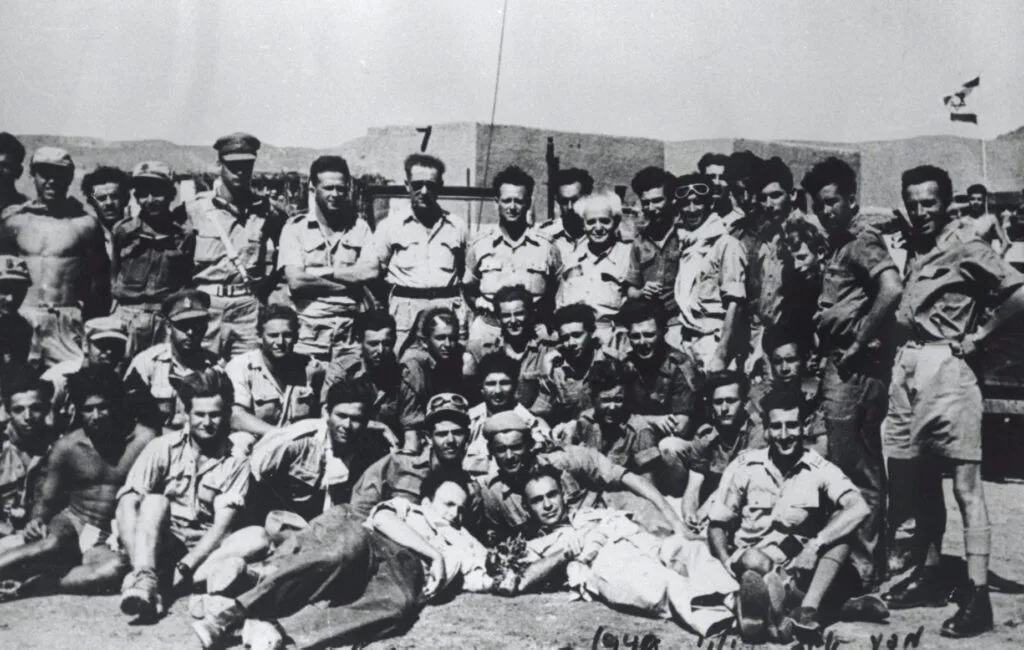
Yitzhak Rabin represents the quintessential soldier-statesman of modern Israel. As the nation’s seventh Chief of General Staff of the Israel Defense Forces (IDF), a two-term Prime Minister, Minister of Defense, Ambassador to Washington, and Nobel Peace Prize laureate, Rabin spent more than five decades at the absolute center of the Jewish state’s military defense, strategic planning, economic modernization, and diplomatic breakthroughs. From commanding elite Palmach units in the 1948 War of Independence and orchestrating the decisive victory of the 1967 Six-Day War, to pioneering the historic Oslo Accords and signing the 1994 Treaty of Peace with Jordan, Rabin’s life embodied the seamless synthesis of uncompromising security readiness with a visionary, courageous pursuit of regional peace.
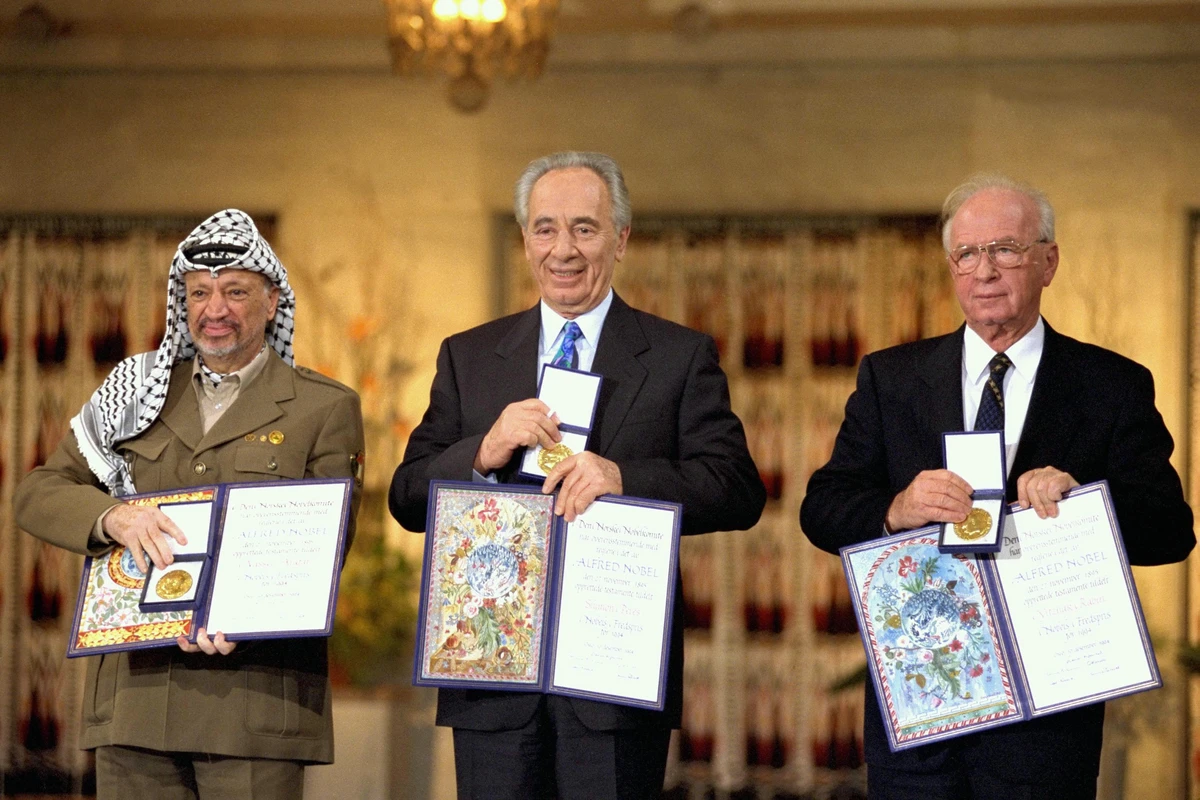
(via Wikimedia Commons, CC BY-SA 3.0).
Official portrait of Prime Minister Yitzhak Rabin, whose military leadership and statesmanship redefined Israeli security doctrine and Middle Eastern diplomacy.
Executive Takeaways: Military Genius, Statesmanship & Historical Impact
- First Native-Born Prime Minister (Sabra): Born in Jerusalem in 1922, Rabin was the first Prime Minister born in the Land of Israel, symbolizing the generational transition to an indigenous, self-reliant leadership.
- Architect of the 1967 Six-Day War: As IDF Chief of Staff (1964–1968), modernized military doctrine, rapid armor maneuvering, and preemptive air superiority (Operation Focus), securing Israel’s historic military triumph and the reunification of Jerusalem.
- Entebbe Rescue Authorization: During his first term as Prime Minister (1974–1977), authorized the daring Operation Entebbe in July 1976, rescuing over 100 Israeli hostages held by terrorists in Uganda.
- Economic & Educational Transformation: In his second premiership (1992–1995), dramatically redirected national investment into domestic infrastructure, doubled education budgets, and fostered the high-tech economic boom.
- Historic Peace Architecture: Co-architect of the Oslo Accords (awarded the Nobel Peace Prize in 1994) and author of the landmark 1994 Israel-Jordan Peace Treaty, opening diplomatic, security, and economic ties across the Arab world.
1. Early Life, Ancestral Heritage, and Formative Education in Tel Aviv
Yitzhak Rabin was born on March 1, 1922, in Jerusalem during the opening years of the British Mandate. His father, Nehemiah Rubitzov (later Rabin), was born in Ukraine, emigrated to the United States as a young man, and joined the Jewish Legion during World War I to fight under British command for the liberation of Palestine. His mother, Rosa Cohen—widely revered as “Red Rosa”—was a legendary labor pioneer, Haganah underground organizer, and member of the Tel Aviv City Council who dedicated her life to social welfare, public health, and workers’ rights.
Growing up in Tel Aviv, Rabin was raised in an austere environment of civic duty, socialist idealism, and modest living. He attended the Beit Hinuch LeYaldei Ovdim (School for Workers’ Children), an institution emphasizing labor solidarity, collective responsibility, and intellectual rigor. Following the death of his mother in 1937 when he was just fifteen, Rabin dedicated himself with intense discipline to his studies.
In 1937, Rabin enrolled at the prestigious Kadoorie Agricultural High School in the Lower Galilee. Known for its rigorous academic curriculum and high admission standards, Kadoorie educated many of Israel’s future military and political leaders. Rabin excelled in hydrology, mathematics, and soil mechanics, graduating with top honors in 1940. His ambition was to travel to the University of California, Berkeley, to study irrigation and water engineering, aspiring to transform the arid landscapes of the Negev. However, the escalating global conflagration of World War II and the imminent threat of Axis forces advancing toward the Middle East permanently altered his life trajectory.
2. The Palmach Crucible: Clandestine Warfare and Allied Operations (1941–1947)
In May 1941, under the shadow of German Field Marshal Erwin Rommel’s Afrika Korps advancing across North Africa toward the Suez Canal, the Haganah leadership established the Palmach (Plugot Machatz, or Strike Companies)—an elite, highly trained commando force. Rabin was among its very first recruits, enlisted personally by its founding commander, Yigal Allon.
Rabin’s initial operational baptism occurred in June 1941 during the Allied invasion of Vichy French-controlled Lebanon and Syria. Rabin led clandestine reconnaissance units behind enemy lines, cutting communications cables and guiding Australian and British forces through hostile terrain. Over the next six years, Rabin rose rapidly through the Palmach ranks, demonstrating exceptional tactical analytical capability, operational calm under fire, and mastery of field maneuvers.
In October 1945, during the growing Jewish resistance against the restrictive British White Paper policies, Rabin planned and executed the famous raid on the Atlit Detention Camp, successfully liberating 208 undocumented Jewish refugees who had been interned by British authorities. During “Operation Agatha” (Black Saturday) in June 1946, Rabin was arrested by British security forces and detained for five months at the Rafah internment camp, an experience that reinforced his conviction in the absolute necessity of sovereign Jewish independence.
3. The 1948 War of Independence: Commander of the Harel Brigade and the Battle for Jerusalem
With the passage of the UN Partition Plan in November 1947 and the outbreak of hostilities, Jerusalem came under intense siege by local Arab irregulars and, subsequently, the British-officered Transjordanian Arab Legion. The city’s 100,000 Jewish residents were cut off from food, water, medical supplies, and ammunition.
In April 1948, David Ben-Gurion and the Haganah command appointed the 26-year-old Rabin as commander of the newly formed Harel Brigade. Rabin was tasked with the most perilous and vital mission of the war: breaking the blockade along the treacherous, mountainous highway through Bab el-Wad (Sha’ar HaGai) and keeping the supply lifeline to Jerusalem open.
Rabin’s brigade fought continuous, bloody day-and-night battles along the rocky ridges of the Jerusalem corridor. The brigade suffered devastating casualties—losing hundreds of its finest young officers and fighters—but Rabin’s unyielding command ensured that armored supply convoys breached the siege. The rusted hulks of those improvised armored vehicles remain preserved along Highway 1 today as an eternal national memorial to the sacrifice of Rabin’s Harel Brigade.
Following the opening of the “Burma Road” bypass, Rabin served as Deputy Commander of Operation Danny under Yigal Allon in July 1948, capturing the strategic hubs of Lydda and Ramle and securing the approaches to Tel Aviv. Later in the war, as Chief of Operations for the Southern Front, Rabin co-designed Operation Yoav and Operation Horev, driving Egyptian forces entirely out of the Negev and securing the modern southern borders of the State of Israel. In 1949, Rabin participated as a key military representative in the Rhodes Armistice negotiations, drafting the armistice agreements that ended the war.
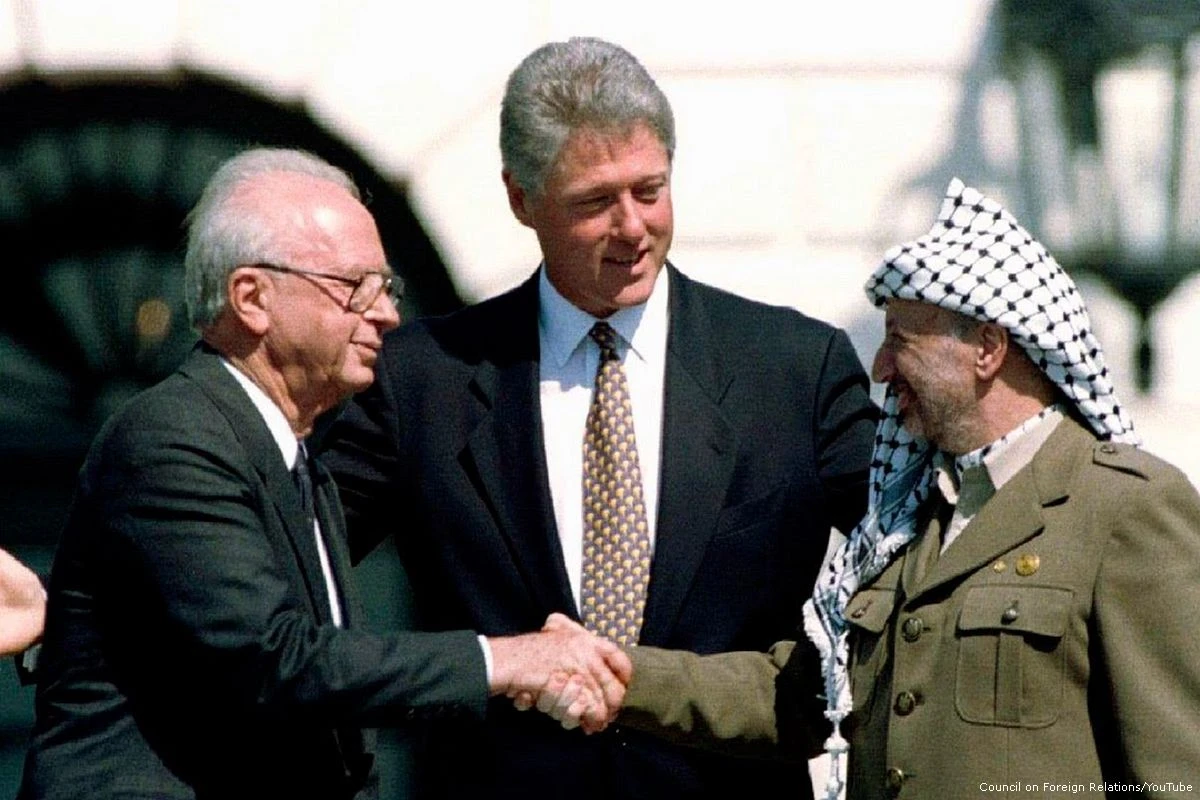
(via Wikimedia Commons, Public domain).
Prime Minister Yitzhak Rabin and PLO Chairman Yasser Arafat shaking hands on the White House South Lawn alongside President Bill Clinton during the historic signing of the Declaration of Principles in September 1993.
4. Professionalizing the IDF: Camberley, GHQ, and Strategic Doctrine (1950–1963)
Following the War of Independence, Rabin chose to remain in the permanent military service of the newly formed IDF. In 1953, he was sent to the prestigious British Army Staff College at Camberley, graduating at the top of his international class and gaining profound mastery of large-scale staff organization, combined-arms doctrine, and modern military logistics.
Returning to Israel, Rabin served successively as Head of the Training Directorate (where he authored standard IDF training manuals), Commander of the Northern Command (1956–1959), and Head of the Operations Directorate (Agaf Mivtzaim) and Deputy Chief of Staff under Zvi Tzur (1961–1963).
During this formative decade, Rabin laid the structural and philosophical foundations of the IDF:
- The Doctrine of Preemption: Recognizing Israel’s lack of strategic depth and asymmetric geographic vulnerability, Rabin established the military imperative to rapidly preempt hostile concentrations and transfer combat into enemy territory immediately upon the outbreak of conflict.
- The Supremacy of Air Power: Championed heavy investment in the Israeli Air Force (IAF), demanding relentless precision training, rapid aircraft turnaround times, and advanced electronic warfare capabilities.
- Armored Maneuver Warfare: In close cooperation with Major General Israel Tal, transformed the Armored Corps into a fast-moving, highly disciplined offensive force capable of deep penetration and encirclement.
- The Citizen-Army Reserve Model: Perfected the rapid-mobilization reserve system, enabling a small democratic state to field a formidable modern army within 48 to 72 hours while preserving civil-democratic life during peacetime.
5. Chief of Staff: The 1967 Six-Day War and the Mount Scopus Address (1964–1968)
On January 1, 1964, Prime Minister Levi Eshkol appointed Yitzhak Rabin as the seventh Chief of General Staff of the IDF. Over the next three years, Rabin conducted an exhaustive program of operational readiness, war games, and intelligence integration.
In May 1967, the Middle East plunged into an existential crisis. Egyptian President Gamal Abdel Nasser blockaded the Straits of Tiran to Israeli shipping (a direct act of war), expelled the United Nations Emergency Force (UNEF) peacekeepers from the Sinai Peninsula, and massed over 100,000 troops and 1,000 tanks along Israel’s southern border, while military pacts united Egypt, Syria, Jordan, and Iraq under joint command.
Rabin and the General Staff prepared a masterpiece of preemptive military strategy. On the morning of June 5, 1967, the IAF launched Operation Focus (Mivtza Moked). Flying below enemy radar over the Mediterranean, Israeli fighter jets destroyed the Egyptian, Syrian, and Jordanian air forces on the ground within three hours, securing absolute air supremacy.
Over the next six days of rapid, coordinated maneuvering:
- In the South: IDF armored divisions under Tal, Sharon, and Yoffe shattered Egyptian defenses, advancing across the Sinai Peninsula to the banks of the Suez Canal.
- In the Center: Paratroopers under Motta Gur liberated the Old City of Jerusalem, reuniting the Western Wall and Temple Mount with the Jewish nation for the first time in 1,900 years, while securing Judea and Samaria (the West Bank).
- In the North: IDF forces scaled the precipitous heights of the Syrian Golan Heights, capturing the strategic plateau and ending decades of artillery bombardment against Galilean kibbutzim.
Following the overwhelming victory, Rabin delivered his renowned address upon receiving an honorary doctorate from the Hebrew University of Jerusalem at the Mount Scopus amphitheater on June 28, 1967. Rather than indulging in triumphalism or martial boasting, Rabin articulated the moral solemnity of the Israeli warrior:
“The joy of triumph is not complete; it is marred by grief for the fallen. The soldiers of Israel fought not with hatred for the enemy, but with a deep yearning for life, for freedom, and for peace. We saw our young men weeping not in fear, but in awe and mourning for their comrades. This is the moral spirit of our army.”
6. Ambassador to Washington: Forging the Strategic Alliance (1968–1973)
Retiring from the military in early 1968, Rabin was appointed Israel’s Ambassador to the United States by Prime Minister Levi Eshkol and Foreign Minister Abba Eban. In Washington, Rabin established a relationship of profound mutual respect with President Richard Nixon and National Security Advisor Henry Kissinger.
Rabin understood that Cold War geopolitics presented an opportunity to redefine Israel not merely as a recipient of Western moral support, but as a vital, indispensable strategic asset to the United States. He successfully secured the procurement of supersonic F-4 Phantom fighter-bombers, A-4 Skyhawks, and sophisticated electronic warfare equipment. His diplomacy transformed the US-Israel relationship into a formal, deep-seated strategic partnership encompassing joint intelligence sharing, military technological cooperation, and diplomatic coordination at the United Nations.
7. First Premiership: Post-War Recovery and Operation Entebbe (1974–1977)
Returning to Israel in 1973, Rabin was elected to the Knesset as a member of the Labor Alignment and served briefly as Minister of Labor. Following the resignation of Golda Meir in April 1974 in the wake of the Yom Kippur War, Rabin defeated Shimon Peres in the Labor Party leadership vote and was sworn in on June 3, 1974, as Israel’s fifth Prime Minister—the first native-born Sabra to lead the nation.
Rabin’s first term was marked by decisive strategic and operational achievements:
- The Sinai Interim Agreement (September 1975): Working with Henry Kissinger, Rabin negotiated a historic interim disengagement treaty with Egypt. Israel withdrew from the strategic Gidi and Mitla Passes and returned the Abu Rudeis oilfields in exchange for Egyptian non-belligerency pledges, early-warning monitoring stations, and the reopening of the Suez Canal. This agreement established the essential diplomatic stepping stone for the subsequent Camp David Accords.
- Operation Thunderbolt / Operation Entebbe (July 4, 1976): When an Air France flight carrying over 100 Israeli and Jewish passengers was hijacked by German and Palestinian terrorists to Entebbe Airport in Uganda with the collaboration of dictator Idi Amin, Rabin demonstrated extraordinary executive courage. Rejecting terrorist extortion, he authorized a daring commando rescue mission over 4,000 kilometers from Israel. Led by Sayeret Matkal under Lieutenant Colonel Yoni Netanyahu, the rescue succeeded with breathtaking precision, liberating 102 hostages and stunning the world with Israel’s reach and tactical brilliance.
- Military Reorganization: Restocked IDF armories, integrated computerized battle-management systems, and initiated domestic development of advanced weapons platforms.
8. Minister of Defense: Lebanon Redeployment and the First Intifada (1984–1990)
During the National Unity Governments of 1984–1990, Rabin served as Minister of Defense under rotating Prime Ministers Shimon Peres and Yitzhak Shamir. In this capacity, Rabin supervised the complex, phased withdrawal of IDF troops from the depths of Lebanon in 1985, establishing a narrow Security Zone in southern Lebanon in cooperation with the South Lebanon Army (SLA) to defend northern border communities from rocket attacks while minimizing Israeli casualties.
When the First Intifada erupted in December 1987 in the West Bank and Gaza, Rabin managed the security response with unwavering firmness against violence, while simultaneously reaching a profound strategic realization: low-intensity asymmetrical urban conflict could not be resolved solely through military means. He concluded that long-term security required political separation, direct diplomatic negotiations, and a structured peace settlement with Palestinian leadership. This realization laid the groundwork for his second premiership.
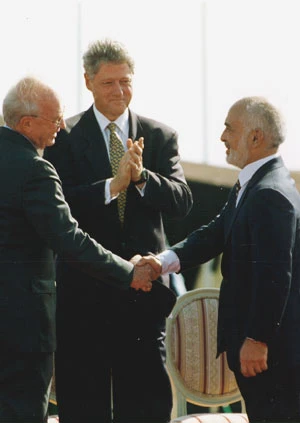
(via Wikimedia Commons, Public domain).
Prime Minister Yitzhak Rabin, King Hussein I of Jordan, and President Bill Clinton at the signing ceremony of the Treaty of Peace between Israel and Jordan in the Arava Valley on October 26, 1994.
9. Second Premiership: The Economic Revolution and High-Tech Boom (1992–1995)
In June 1992, Rabin led the Labor Party to a historic electoral triumph, campaigning under the slogan “Israel is Waiting for Rabin.” Upon taking office as Prime Minister and Minister of Defense, Rabin immediately enacted a bold, comprehensive restructuring of national priorities:
- National Infrastructure Overhaul: Reallocated state budgets from remote ideological settlements toward vital national infrastructure. He initiated the construction of the Trans-Israel Highway (Highway 6), modernized the national rail network, expanded Ben-Gurion International Airport (Terminal 3), and expanded modern highway interchanges across the country.
- The Educational Renaissance: Doubled the national budget for education, introduced computer laboratories into elementary and secondary schools, dramatically increased teachers’ salaries, and expanded funding for research universities and scientific institutes.
- Absorption of the Great Soviet Aliyah: Successfully absorbed and integrated over 750,000 highly educated Jewish immigrants from the former Soviet Union. Rabin created targeted industrial retraining programs and incubator grants, channeling thousands of Soviet mathematicians, computer scientists, physicists, and engineers into Israel’s nascent startup ecosystem, sparking the transformation into the “Startup Nation.”
- Socioeconomic Inclusivity: Substantially increased municipal development budgets for Arab Israeli towns and villages, narrowing socioeconomic disparities and investing in local healthcare, sanitation, and educational facilities.
10. The Oslo Peace Architecture and the Historic White House Handshake
Working in close partnership with Foreign Minister Shimon Peres and Deputy Foreign Minister Yossi Beilin, Rabin authorized confidential negotiations in Oslo, Norway, between Israeli envoys and representatives of the Palestine Liberation Organization (PLO). These secret talks produced the historic Declaration of Principles on Interim Self-Government Arrangements (Oslo I).
On September 13, 1993, on the South Lawn of the White House, hosted by President Bill Clinton, Rabin presided over the signing ceremony and shook hands with PLO Chairman Yasser Arafat. In his address, Rabin delivered one of the most powerful and moving speeches in modern diplomatic history:
“We who have fought against you, the Palestinians, we say to you today in a loud and a clear voice: Enough of blood and tears. Enough! We have no desire for revenge. We harbor no hatred towards you. We, like you, are people who want to build a home, to plant a tree, to love, to live side by side with you in dignity, in empathy, as human beings, as free men.”
In December 1994, in recognition of their historic breakthrough toward Middle Eastern peace, Yitzhak Rabin, Shimon Peres, and Yasser Arafat were jointly awarded the Nobel Peace Prize in Oslo. In his Nobel lecture, Rabin spoke of the sacred obligation of leaders to choose the courageous path of reconciliation over the perpetual cycle of war.
11. The 1994 Israel-Jordan Peace Treaty: A Model of Regional Normalization
Building upon the momentum of the peace process, Rabin realized his lifelong ambition of securing formal peace with Israel’s eastern neighbor, the Hashemite Kingdom of Jordan. Rabin and King Hussein I formed a genuine, deep-seated bond of personal trust, mutual respect, and strategic alignment.
On October 26, 1994, at the southern border crossing in the Arava Valley, Rabin and King Hussein signed the Treaty of Peace between the State of Israel and the Hashemite Kingdom of Jordan in the presence of US President Bill Clinton. The treaty established:
- Delimitation of internationally recognized, secure sovereign borders.
- Comprehensive water-sharing arrangements, providing Jordan with vital fresh water supplies from the Sea of Galilee and desalination infrastructure.
- Close intelligence and joint military border security coordination along the longest international boundary.
- Open diplomatic embassies, bilateral trade agreements, agricultural cooperation, and joint tourism initiatives along the Red Sea (Eilat and Aqaba).
The peace treaty with Jordan stands today as an enduring pillar of regional stability, proving that peace between Israel and Arab nations can be built on mutual trust, shared vital interests, and strategic cooperation.
12. Comprehensive Overview of Yitzhak Rabin’s Military & Political Career
6. The “Waiting Period” of May 1967: Strategic Nerve and Civil-Military Relations
The three weeks preceding the outbreak of the Six-Day War—historically known as the “Waiting Period” (Tkufat HaHamtana)—represented one of the most intense tests of civil-military leadership in Israeli history. When Egyptian forces entered the Sinai demilitarized zone and closed the Straits of Tiran, the Israeli cabinet hesitated, dispatching Foreign Minister Abba Eban to Paris, London, and Washington in an attempt to secure international diplomatic intervention.
Throughout this agonizing delay, Rabin carried the immense physical and mental burden of mobilizing a citizen army whose economic and psychological resources were strained to the limit. Rabin engaged in intense strategic dialogues with founding Prime Minister David Ben-Gurion, who cautioned against acting without great power backing. Rabin, however, maintained that Israel’s military deterrence was indivisible: allowing an explicit casus belli to pass unanswered would invite a coordinated, multi-front assault under vastly disadvantageous conditions.
Rabin’s steadfast coordination with Prime Minister Levi Eshkol and the newly appointed Defense Minister Moshe Dayan forged the operational consensus that enabled the decisive launch of Operation Focus on June 5. Rabin’s meticulous preparations ensured that once the political directive was issued, the IDF executed its operational plan with flawless synchronization and unprecedented speed.
11. The High-Tech Miracle and Socioeconomic Modernization under Rabin’s Second Government
While internationally celebrated for his peace initiatives, Yitzhak Rabin’s second premiership (1992–1995) was equally revolutionary in its domestic economic and scientific achievements. Rabin recognized that in the emerging global information age, national security depended not only on tanks and fighter squadrons, but on scientific excellence, advanced computing, telecommunications, and high-value export industries.
In 1993, Rabin’s government established the historic Yozma Program, a groundbreaking initiative designed by the Ministry of Industry and Trade that offered government co-investment to international venture capital funds investing in Israeli technology startups. This single policy intervention catalyzed the creation of Israel’s venture capital industry, attracting Silicon Valley investors, multinational research and development centers (including Intel, Microsoft, and IBM), and transforming Israel into the world’s most dynamic tech incubator outside California.
Concurrently, Rabin revolutionized national transportation and infrastructure. His administration broke decades of bureaucratic stagnation by commissioning the Cross-Israel Highway (Route 6) as a modern electronic tollway, electrifying regional railways, and constructing state-of-the-art medical complexes in the Galilee and Negev. By reallocating billions of shekels into scientific research and public education, Rabin created the structural economic foundation that powered Israel’s GDP growth throughout the 1990s and 2000s.
Furthermore, Rabin pioneered unprecedented civil equality initiatives for Israel’s Arab citizens. His government increased municipal infrastructure budgets for Arab towns by over 300%, equalized child allowances, established modern healthcare clinics in Arab municipalities, and recruited record numbers of Arab university graduates into the civil service, establishing a model of inclusive democratic citizenship.
12. Strategic Defense Doctrine, Arrow Missile Development, and the Non-Proliferation Paradigm
During his tenure as Minister of Defense and Prime Minister, Yitzhak Rabin was a visionary champion of next-generation defense technologies designed to safeguard Israel against long-range ballistic missile threats. Following the 1991 Gulf War, during which Iraqi Scud missiles struck Israeli population centers, Rabin recognized that the character of Middle Eastern warfare was undergoing a fundamental transformation from border armor clashes to stand-off missile trajectories.
Rabin accelerated the joint US-Israel development of the Arrow (Hetz) Anti-Ballistic Missile System, partnering with Israel Aerospace Industries (IAI) and the US Ballistic Missile Defense Organization. Rabin’s personal diplomacy with President Bill Clinton ensured multi-hundred-million-dollar American co-funding for the project, laying the structural foundation for Israel’s multi-layered missile defense architecture (including Iron Dome, David’s Sling, and Arrow-3) that protects Israeli skies today.
Simultaneously, Rabin maintained Israel’s traditional policy of strategic ambiguity regarding its sovereign deterrent capabilities, famously stating: “Israel will not be the first to introduce nuclear weapons into the Middle East, but neither will it be the second.” His rigorous, realistic security doctrine ensured that Israel negotiated from an unassailable position of military and technological strength.
14. Civil-Military Ethics, Democratic Norms, and Uncompromising Integrity
Throughout his long career in public life, Yitzhak Rabin was revered across the Israeli political spectrum for his absolute personal integrity, unpretentious lifestyle, and deep fidelity to democratic norms. He rejected political sycophancy, speaking with a blunt, analytical honesty that became his hallmark. Whether addressing the Knesset, negotiating with foreign heads of state, or speaking with IDF combat soldiers in dusty field briefings, Rabin was renowned for his directness and complete absence of personal vanity.
In 1977, when it was revealed that his wife Leah had maintained a modest bank account in Washington from his tenure as ambassador—in technical violation of then-strict currency regulations—Rabin took full personal responsibility and resigned immediately from the premiership and party leadership. This act of uncompromising ethical accountability set a standard of democratic public service that earned him enduring public respect.
Rabin believed profoundly that the ultimate strength of the State of Israel lay not merely in its military hardware, but in its democratic cohesion, the moral quality of its society, and its unwavering commitment to justice. His legacy stands as an eternal testament to the ideal of the soldier-statesman who uses military strength to protect his nation while dedicating his life to the noble pursuit of lasting peace.
14. Global Statesmanship and Memorial Tributes Worldwide
Following his tragic assassination on November 4, 1995, Yitzhak Rabin was mourned by world leaders across the globe. His state funeral on Mount Herzl was attended by over eighty heads of state and government, including US President Bill Clinton, Egyptian President Hosni Mubarak, King Hussein of Jordan, and European prime ministers.
President Clinton’s immortal farewell eulogy—“Shalom, Chaver” (Goodbye, Friend)—became a worldwide symbol of respect for a warrior who dedicated his final years to peace. Today, major avenues, schools, hospitals, and public squares across Israel and international capitals bear his name, memorializing a life dedicated entirely to the sovereignty, security, and peace of the State of Israel.
| Era & Role | Years | Key Operations & Policies | Strategic Contribution to Israel |
|---|---|---|---|
| Palmach Commander / Harel Brigade | 1941–1949 | Bab el-Wad convoys; breaking the siege of Jerusalem; Operation Danny & Operation Yoav | Secured the lifeline to Jerusalem and defended sovereign southern borders |
| IDF Chief of General Staff | 1964–1968 | Operation Focus; liberation of Jerusalem; victory in the 1967 Six-Day War; Mount Scopus address | Established air superiority doctrine and reunited Jerusalem under Israeli sovereignty |
| Ambassador to the United States | 1968–1973 | Phantom jet procurement; strategic alliance with Nixon administration | Cemented the institutional US-Israel defense and intelligence partnership |
| Prime Minister (First Term) | 1974–1977 | Sinai Interim Agreement; Operation Entebbe hostage rescue; post-Yom Kippur War recovery | Rebuilt deterrence and laid framework for peace with Egypt |
| Minister of Defense | 1984–1990 | IDF redeployment to South Lebanon Security Zone; managing First Intifada security | Protected northern border communities; developed pragmatic security doctrine |
| Prime Minister (Second Term) | 1992–1995 | Oslo Accords; Israel-Jordan Peace Treaty; Nobel Peace Prize; national infrastructure revolution | Opened regional diplomatic ties; ignited Israel’s high-tech economic boom |
13. Martyrdom, Eternal Memory, and the Heritage of Peace
On Saturday evening, November 4, 1995, Yitzhak Rabin attended a massive peace rally in Kings of Israel Square (now Rabin Square) in Tel Aviv under the banner “Yes to Peace, No to Violence.” Over 100,000 citizens filled the plaza, singing together with Rabin the popular anthem Shir LaShalom (Song for Peace). As Rabin concluded his address and walked down the steps toward his car, he was struck down by three bullets fired by a right-wing extremist fanatic seeking to halt the peace process. In his jacket pocket was a folded, blood-stained paper containing the printed lyrics of the song of peace.
Rabin’s state funeral on Mount Herzl in Jerusalem brought together heads of state and dignitaries from over 80 nations, including US President Bill Clinton, former Presidents Jimmy Carter and George H.W. Bush, Egyptian President Hosni Mubarak, and King Hussein of Jordan, who delivered an emotionally devastating eulogy mourning his “brother, colleague, and true friend.” President Clinton concluded his moving eulogy with the immortal Hebrew farewell: “Shalom, Chaver” (Goodbye, Friend).
Today, Yitzhak Rabin is remembered throughout Israel and the world as an iconic leader of unblemished integrity, formidable military intellect, and profound moral courage. He proved that an uncompromising military warrior who fought across every battlefield in defense of his homeland could also possess the visionary audacity to lead his people toward historic reconciliation and regional peace. His enduring legacy remains an eternal beacon of democratic leadership and strategic hope.