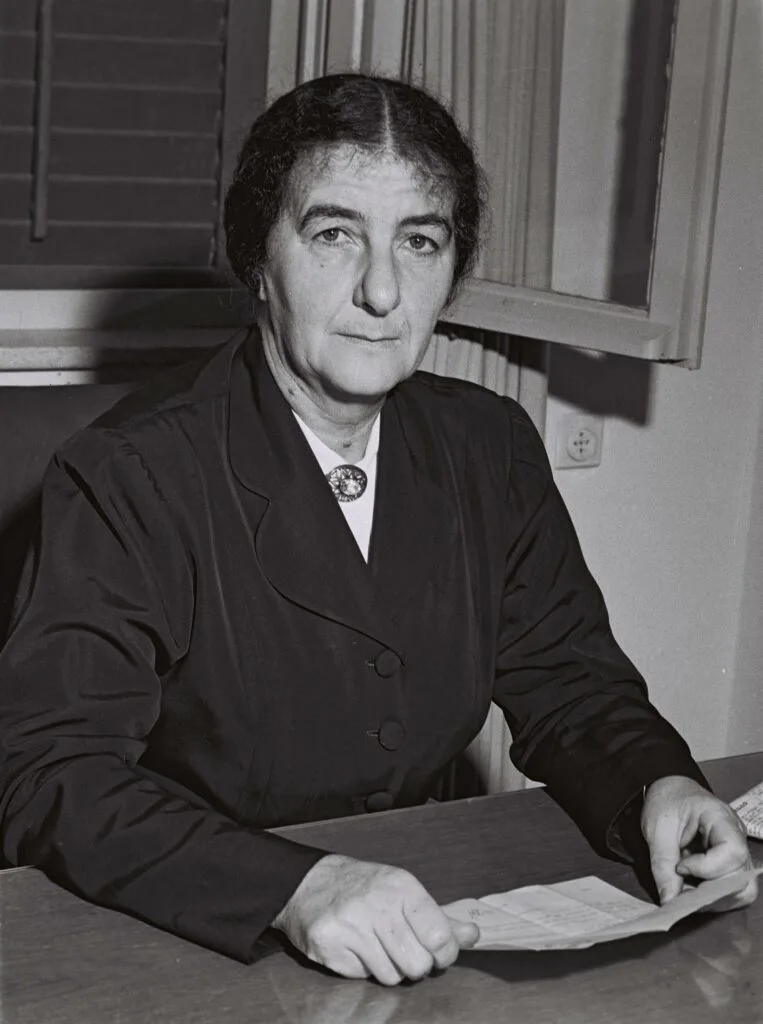
Golda Meir stands as one of the most formidable, consequential, and inspiring figures in twentieth-century world politics. As the fourth Prime Minister of Israel and only the third woman in modern history to be democratically elected head of government, Meir dedicated more than six decades of public service to the creation, defense, diplomatic recognition, and socioeconomic development of the Jewish state. From her childhood in Tsarist Kyiv and formative political awakening in Milwaukee, Wisconsin, to the highest councils of international diplomacy, her life embodied an unyielding commitment to national sovereignty, labor solidarity, social welfare, and strategic resilience. Her extraordinary trajectory mirrors the rebirth of the Jewish nation, moving from vulnerability and displacement to sovereign statehood and institutional permanence.
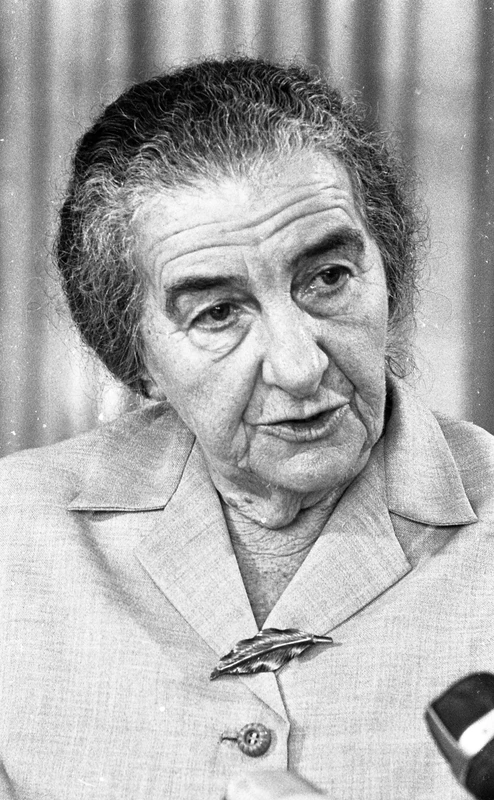
(via Wikimedia Commons, CC BY 4.0).
Official portrait of Prime Minister Golda Meir, whose historic leadership guided Israel through early statehood, labor infrastructure building, and the 1973 Yom Kippur War.
Executive Takeaways: Strategic Leadership & Historic Legacy
- Architect of Statehood & Defense Financing: Raised an unprecedented $50 million in 1948 across the United States, securing the vital foreign currency necessary to equip and arm the nascent Israel Defense Forces (IDF) during the War of Independence.
- Pioneering Social Infrastructure: As Minister of Labor (1949–1956), engineered the National Insurance Institute (Bituach Leumi), massive public housing schemes (Amidar), and major arterial roads that integrated hundreds of thousands of newly arrived immigrants.
- Diplomatic Expansion into the Developing World: As Foreign Minister (1956–1966), established Israel’s visionary international cooperation agency (MASHAV), providing agricultural, medical, and technical expertise to emerging nations across Africa and Asia.
- Global Statesmanship: Forged deep strategic ties with the United States, securing vital defense assistance during the Cold War and establishing the bipartisan American commitment to Israeli security.
- Crisis Leadership: Navigated the existential crisis of the 1973 Yom Kippur War, ordering decisive mobilization, securing emergency US logistical support, and laying the groundwork for subsequent military disengagement pacts.
1. Early Life, Tsarist Persecution, and the Roots of Zionist Conviction
Golda Mabovitch was born on May 3, 1898, in Kyiv, then part of the Russian Empire, into an impoverished Jewish household. Her father, Moshe Mabovitch, was a skilled carpenter who struggled constantly to find steady employment within the restrictive confines of the Pale of Settlement. Her mother, Blume Neiditch, did everything possible to keep the family fed during brutal Ukrainian winters. Of the eight children born to the family, only Golda and two sisters—Sheyna and Tzipke—survived infancy, a grim reality of the severe material deprivation and lack of basic medical care that afflicted Jewish families in Tsarist Russia.
Her earliest conscious memory was one of raw fear and defensive vulnerability. In her celebrated 1975 autobiography, My Life, Meir vividly described standing on the landing of their small apartment as her father frantically boarded up the front entrance with heavy planks of wood after receiving word that an anti-Jewish pogrom was advancing through the neighborhood. The sound of shouting mobs, distant glass shattering, and the look of desperate determination on her father’s face left an indelible impression on young Golda. She realized that in the diaspora, Jewish existence was inherently precarious, dependent entirely on the whims of hostile rulers and unprotected by the rule of law. This foundational insight shaped her lifelong conviction that the Jewish people required a sovereign, self-defending state where they would never again be subjected to the mercy of others.
In 1903, seeking economic opportunity and safety from persecution, Moshe Mabovitch emigrated to the United States, finding work in Milwaukee, Wisconsin. Three years later, in 1906, having saved sufficient funds to purchase transatlantic steamship tickets, he sent for Blume and the three girls. The family joined him in Milwaukee, settling into a modest flat in the city’s growing Jewish immigrant quarter.
2. The Milwaukee Years, Intellectual Awakening, and Flight to Denver
In Milwaukee, Golda adapted rapidly to American life, learning English with remarkable speed and excelling academically at the Fourth Street School (now renamed the Golda Meir School in her honor). Her innate leadership instincts and deep social conscience manifested early. At the age of eleven, discovering that many of her immigrant classmates could not afford to purchase the required textbooks, Golda organized her friends into the American Young Sisters Society. She rented a local meeting hall, coordinated with neighborhood merchants, and staged a public fundraising event, delivering an impassioned speech that raised enough funds to purchase textbooks for every needy child in her grade.
Despite her academic success, her parents maintained traditional nineteenth-century perspectives regarding female education, insisting that a girl did not need higher education and should leave school at age fourteen to marry. When her mother arranged for her to marry an older local businessman, Golda rebelled. In 1912, with the assistance of her older sister Sheyna who had moved to Denver, Colorado, for tuberculosis treatment, the fourteen-year-old Golda secretly bought a train ticket and fled westward.
The home of Sheyna and her husband Shamai Korngold in Denver was a dynamic intellectual haven. Night after night, Jewish immigrants, anarchists, trade union organizers, and socialist thinkers gathered around the samovar to debate philosophy, literature, women’s suffrage, and political theory. In these intense discussions, Golda encountered the philosophy of Labor Zionism (Poale Zion)—the idea that Jewish national liberation must be achieved not through diplomatic declarations alone, but through physical labor, agricultural pioneering, cooperative economics, and social justice.
It was also in Denver that Golda met Morris Meyerson, a gentle, highly educated sign painter who possessed a deep love for poetry, classical music, and world literature. Morris broadened Golda’s cultural horizons, while Golda ignited Morris’s commitment to social activism. Following reconciliations with her parents, Golda returned to Milwaukee to finish high school at North Division High School, graduating in 1916. She subsequently enrolled at the Milwaukee State Normal School (now the University of Wisconsin–Milwaukee) to train as an educator, while becoming a prominent young organizer and orator for Poale Zion across North America.
3. Aliyah to Mandatory Palestine: Pioneering on Kibbutz Merhavia
In December 1917, Golda and Morris were married, with Golda stipulating from the outset that their future lay in the Land of Israel. In May 1921, fulfilling their dream, Golda, Morris, and Sheyna joined a group of American pioneers aboard the steamship SS Pocahontas, embarking on a hazardous and difficult transatlantic journey to Mandatory Palestine.
Upon arrival, the young couple applied for membership at Kibbutz Merhavia in the Jezreel Valley. The veteran kibbutzniks initially looked upon the American city girl with skepticism, doubting that she possessed the physical endurance and resilience required for life in an undeveloped agricultural commune plagued by malaria and scorching summer heat. Golda quickly shattered these preconceptions. She volunteered for the most demanding tasks: planting almond orchards, digging irrigation ditches, tending the poultry runs, and managing the communal kitchen.
Her organizational clarity, practical common sense, and egalitarian spirit earned the deep respect of her peers. Merhavia soon elected her as its delegate to the newly established Histadrut (General Federation of Labor), marking the beginning of her public political career. However, Morris struggled with recurring bouts of malaria and found communal life taxing. In 1924, prioritizing his health, the couple moved to Jerusalem, where they had two children, Menachem (born 1924) and Sarah (born 1926).
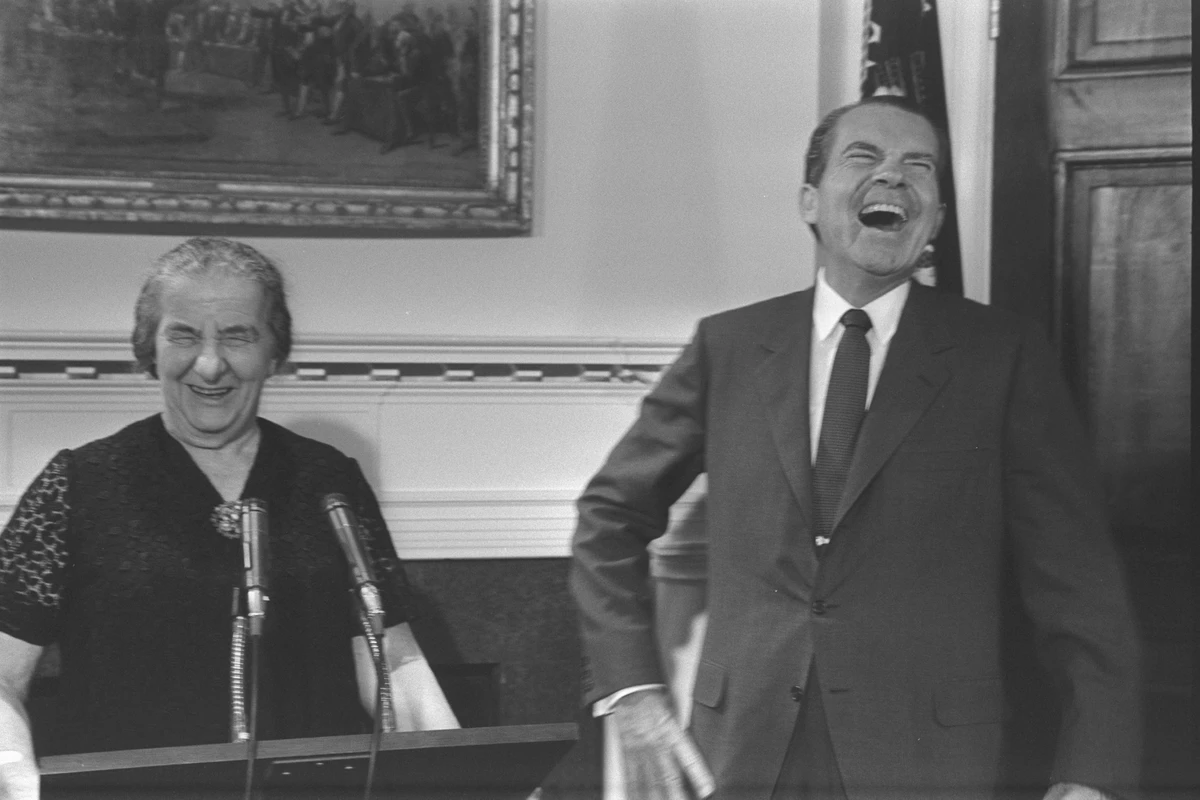
(via Wikimedia Commons, Public domain).
Prime Minister Golda Meir conferring with US President Richard Nixon at the White House in September 1969, cementing the enduring US-Israel strategic alliance.
4. Ascending the Labor Movement: Moetzet HaPoalot and the Histadrut
Life in Jerusalem during the mid-1920s was financially arduous. To support her family, Golda took in laundry and taught English in local schools. In 1928, her immense organizing talent was recognized when David Remez invited her to become Secretary of Moetzet HaPoalot (the Working Women’s Council). In this executive role, Meir dedicated herself to the socioeconomic advancement of female pioneers, establishing agricultural training farms for women, day-care centers for working mothers, and vocational programs.
Between 1932 and 1934, Meir spent two years in the United States as the official emissary of the Women’s Labor Organization, traveling across dozens of cities to raise funds, educate American Jewish communities about the pioneering enterprise in Palestine, and mobilize political support. Upon returning to Mandatory Palestine, she was appointed to the Executive Committee of the Histadrut, eventually ascending to lead its influential Political Department.
During the 1930s and through World War II, Meir functioned as one of the Yishuv’s most effective administrators and negotiators. She represented the Jewish labor movement before British commissions of inquiry, coordinated with industrial employers, and played a central role in managing the Yishuv’s wartime economic mobilization in support of the Allied forces fighting Nazi Germany. In 1938, she attended the Evian Conference in France as the Jewish observer from Palestine, watching in sorrow as world powers refused to open their borders to millions of imperiled European Jews—an experience that cemented her resolve that statehood was a matter of life and death.
5. The 1946 Crisis, Operation Agatha, and the Emergency American Mission
On June 29, 1946, the British Mandatory administration executed “Operation Agatha” (Black Saturday), deploying thousands of soldiers to raid Jewish institutions across Palestine, arrest senior leaders of the Jewish Agency, and confiscate Haganah defense records. With Moshe Sharett, David Remez, and other primary executives imprisoned in the Latrun detention camp, Golda Meir was appointed Acting Head of the Jewish Agency’s Political Department.
Over the following two critical years leading to the expiration of the British Mandate, Meir served as the de facto Foreign Minister and chief civilian diplomat of the Yishuv. She met repeatedly with British High Commissioner Sir Alan Cunningham, testified with eloquence before the United Nations Special Committee on Palestine (UNSCOP), and coordinated the clandestine immigration networks (Aliyah Bet) that ferried tens of thousands of Holocaust survivors through the British naval blockade.
In January 1948, following the UN Partition Resolution of November 29, 1947, the pre-state Jewish community faced immediate armed attacks from local irregulars and the certainty of a coordinated multi-national invasion by regular Arab armies. The Yishuv was critically short of foreign currency needed to purchase arms and ammunition from international suppliers. David Ben-Gurion estimated that at least $25 million was required immediately to prevent military collapse.
Golda volunteered to travel to the United States on an emergency fundraising tour. Arriving in New York, she traversed the American continent, delivering unscripted, impassioned addresses to packed assemblies of American Jews in Chicago, Miami, Cleveland, Philadelphia, and Los Angeles. She spoke not in diplomatic abstractions, but with direct moral authority:
“We are not better than you who are here. We are merely there, on the front line… If we have to go down, we will go down fighting. But we need the tools to survive. The Jewish community in Palestine will fight to the very end. We ask you to give us the means to win.”
Her speeches unleashed an overwhelming wave of generosity. In less than three months, Meir raised more than $50 million—more than double the initial goal and triple the entire annual budget of the British Mandatory administration in Palestine. These vital funds financed Operation Balak, securing the Czech arms shipments of rifles, machine guns, artillery, and Avia S-199 fighter aircraft that arrived just as regular Arab armies invaded, turning the tide of the War of Independence. David Ben-Gurion later famously remarked: “Some day when history is written, it will be said that there was a Jewish woman who got the money which made the state possible.”
6. The Secret Clandestine Mission to King Abdullah I of Jordan
In the days immediately preceding the declaration of statehood, Golda Meir undertook one of the most daring diplomatic missions in modern history. On May 10, 1948, dressed in traditional Arab disguise as an Arab woman accompanied by Ezra Danin, she traveled secretly across hostile territory into Amman to meet with King Abdullah I of Transjordan in a final attempt to avert war.
During the tense late-night negotiations, King Abdullah urged Meir not to declare an independent Jewish state, proposing instead that Jewish areas be incorporated as an autonomous province under his crown. Meir firmly rejected the offer, stating: “We are fighting for our historic right to statehood. If you force war upon us, we will fight and we will win.” When the King asked why the Jewish leadership was in such a hurry to declare independence, Meir famously replied: “We have waited two thousand years. Is that hurrying?” Though war could not be averted, the meeting established lines of communication and clarified the strategic parameters of the impending conflict.
7. Signer of the Declaration and Ambassador to Moscow
On May 14, 1948 (5 Iyar 5708), Golda Meir was one of only two women among the 37 signatories of the Israeli Declaration of Independence at the Tel Aviv Museum. Recalling the profound moment, she wrote: “After I signed, I cried. When I studied American history as a schoolgirl and read about those who signed the Declaration of Independence, I couldn’t imagine these were real people doing something real. And there I was, signing our declaration of statehood.”
Following statehood, Ben-Gurion appointed Meir as Israel’s first diplomatic envoy (Minister Plenipotentiary) to the Soviet Union. Arriving in Moscow in September 1948, she presented her credentials to the Soviet government during the height of Joseph Stalin’s totalitarian rule.
On Rosh Hashanah and Yom Kippur of 1948, an unprecedented phenomenon occurred. More than 50,000 Soviet Jews spontaneously gathered outside the Moscow Choral Synagogue on Arkhipova Street to catch sight of the Israeli envoy. Surging around Meir, the crowd wept, cheered, and shouted “Golda! Golda!” and “Am Yisrael Chai!” (The People of Israel Lives!). This spontaneous demonstration broke through decades of state-enforced terror and isolation, signaling to the world that Soviet Jewry’s national and cultural identity remained vibrant despite intense communist repression.
8. Minister of Labor: Masterminding National Infrastructure and the Welfare State (1949–1956)
In 1949, Meir returned to Israel to take her seat in the First Knesset and was appointed Minister of Labor by Ben-Gurion. For seven transformative years, she led the ministry responsible for solving the greatest domestic challenge in Israeli history: absorbing more than 700,000 Jewish immigrants from war-torn Europe and ancient communities across the Arab world (Yemen, Iraq, Morocco, Tunisia, Libya, and Egypt), doubling the nation’s population in under four years.
Meir tackled the crisis with immense energy and pragmatic planning:
- Abolition of the Ma’abarot (Transit Camps): Spearheaded the massive public housing construction initiative through the state-owned housing corporation, Amidar. Under her direction, over 200,000 permanent residential apartments were constructed, systematically replacing temporary canvas tents and tin shacks with modern brick-and-mortar homes.
- The National Highway Grid: Initiated large-scale public works projects that paved thousands of kilometers of arterial highways, connecting peripheral development towns in the Negev (Dimona, Beersheba, Yerucham) and the Galilee (Kiryat Shmona, Hatzor, Karmiel) with commercial coastal hubs.
- The National Insurance Law (1954): Conceptualized, drafted, and guided through the Knesset the foundational social security legislation of Israel, establishing the National Insurance Institute (Bituach Leumi). This act created universal maternity benefits, old-age pensions, workplace disability insurance, and survivor support, establishing Israel as a modern social welfare democracy.
- Vocational and Technical Education: Created a nationwide network of vocational training centers, equipping hundreds of thousands of new immigrants with essential skills in construction, masonry, carpentry, machining, industrial manufacturing, and agricultural technology.
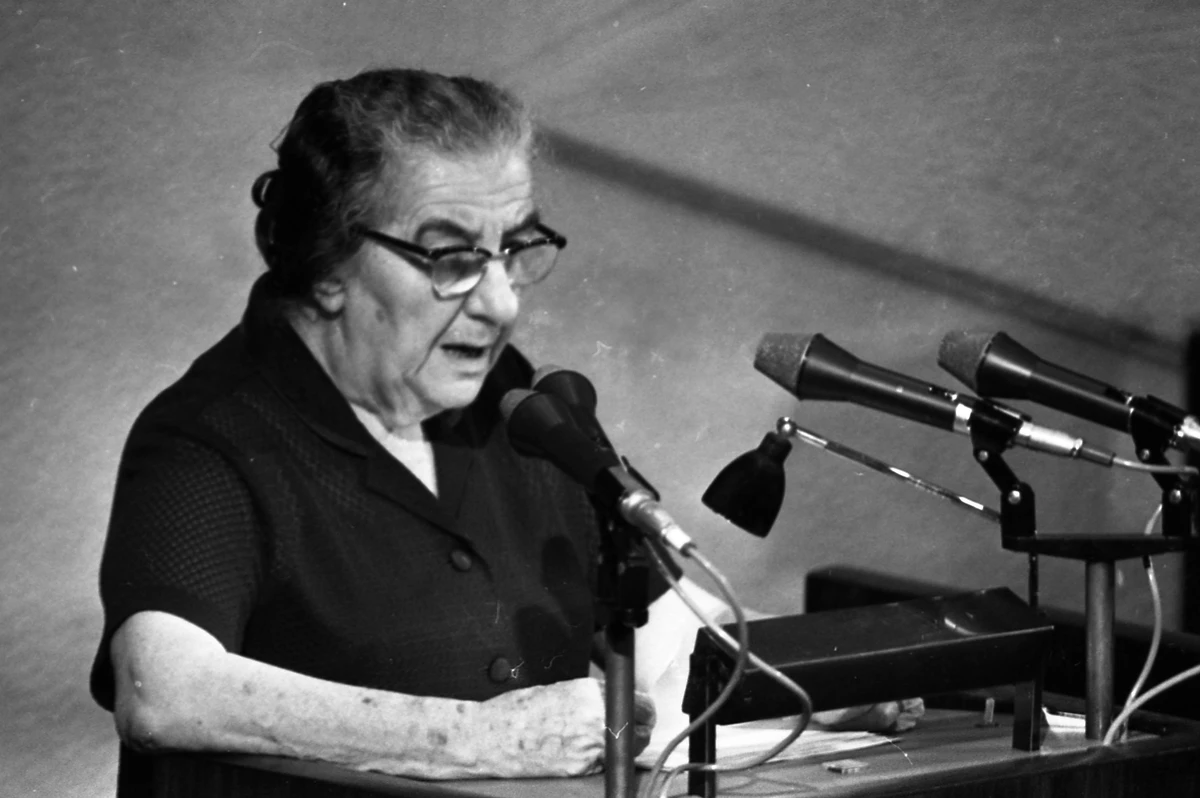
(via Wikimedia Commons, CC BY 4.0).
Prime Minister Golda Meir addressing the Knesset plenary in Jerusalem during a historic parliamentary debate on national security and civic resilience.
9. Minister of Foreign Affairs: The African Cooperation Initiative and Global Alliances (1956–1966)
In June 1956, Prime Minister Ben-Gurion appointed Golda to succeed Moshe Sharett as Minister of Foreign Affairs, asking her to Hebraize her surname; she chose “Meir,” meaning “to illuminate.” For a full decade, Meir directed Israeli foreign policy with remarkable vision, clarity, and determination.
Her signature foreign policy breakthrough was Israel’s historic outreach to the newly independent nations of Sub-Saharan Africa. Recognizing that African nations emerging from colonialism faced the exact same developmental challenges Israel had recently conquered—arid land reclamation, irrigation engineering, public health improvement, and cooperative agricultural planning—Meir founded MASHAV (Israel’s Agency for International Development Cooperation) in 1958.
Under MASHAV’s leadership, Israeli agronomists, hydrologists, ophthalmologists, and public health experts established model cooperative farms, rural clinics, eye hospitals, and irrigation networks across Ghana, Nigeria, Kenya, Ethiopia, Ivory Coast, Uganda, and Tanzania. Concurrently, thousands of African trainees studied at Israeli universities and agricultural institutes. This visionary diplomacy earned Israel immense international goodwill and established strong multilateral voting coalitions at the United Nations.
Simultaneously, Meir deepened Israel’s strategic partnerships in the West. She worked closely with French leadership to secure advanced defense systems, including Mirage jet interceptors, and engaged in critical high-level diplomacy with the Kennedy and Johnson administrations in Washington. Her diplomacy culminated in the historic sale of Hawk surface-to-air missile systems in 1962—the first direct US defensive military export to Israel, cementing the foundation of the modern US-Israel strategic alliance.
10. Prime Minister: Executive Governance, Domestic Growth, and Crisis Command (1969–1974)
Following the sudden death of Prime Minister Levi Eshkol in February 1969, the Labor Party selected Golda Meir as a unifying national leader. On March 17, 1969, she was sworn in as Israel’s fourth Prime Minister. In the national elections of October 1969, Meir led the Alignment coalition to capture 56 Knesset seats—the largest parliamentary mandate ever achieved by a single political bloc in Israeli history.
Meir’s premiership was marked by major domestic and strategic milestones:
- The War of Attrition (1969–1970): Maintained steadfast military defense along the Suez Canal against Soviet-backed Egyptian artillery bombardments, balancing frontline military deterrence with constructive engagement in American diplomatic initiatives, culminating in the August 1970 ceasefire.
- Solidifying the US Strategic Relationship: Established an exceptionally close personal and strategic rapport with US President Richard Nixon and National Security Advisor Henry Kissinger. This partnership established long-term American military credits and modern weapons platforms, including F-4 Phantom supersonic fighter-bombers.
- Social Equity and Welfare Reform: Responded proactively to urban social tensions by creating the Prime Minister’s Commission on Children and Youth in Distress, directing substantial state funding to education, subsidized daycare centers, and infrastructure in development towns and disadvantaged urban neighborhoods.
- Counter-Terrorism Operations: Following the tragic massacre of eleven Israeli Olympic athletes at the 1972 Munich Games, Meir authorized decisive intelligence operations (Operation Wrath of God) to dismantle hostile terrorist networks across Europe and safeguard Israeli citizens worldwide.
11. The Crucible of the 1973 Yom Kippur War: Crisis Command and Diplomatic Fortitude
The most severe trial of Golda Meir’s life occurred on October 6, 1973, when Egyptian and Syrian forces launched a massive, coordinated surprise attack on Yom Kippur, the holiest day of the Jewish calendar. In the tense pre-dawn hours preceding the invasion, despite conflicting intelligence assessments and advice from military analysts suggesting an attack was improbable, Meir demonstrated crucial executive judgment by ordering a full mobilization of IDF reserve forces, overruling more conservative recommendations.
Simultaneously, Meir made the prudent strategic decision to refrain from launching a preemptive air strike. She understood that in the Cold War geopolitical environment, Israel required absolute international clarity as the aggrieved party to secure emergency US diplomatic and logistical support. Her decision proved vital.
Throughout three weeks of brutal combat, Meir provided calm, steadfast civilian leadership from the underground command bunker in Tel Aviv. Working around the clock with the military high command and communicating directly with President Nixon and Henry Kissinger, she secured Operation Nickel Grass—the emergency American military airlift that delivered vital replacement munitions, tanks, and avionics. Under her governance, the IDF rallied from early setbacks to repel Syrian forces on the Golan Heights, push to within artillery range of Damascus, and cross the Suez Canal to encircle the Egyptian Third Army.
Following the ceasefire, the government formed the Agranat Commission of Inquiry to investigate the intelligence and operational failures preceding the war. The Commission’s report explicitly cleared Meir of personal culpability, praising her decisive reserve call-up on the morning of Yom Kippur. However, recognizing the intense national grief and holding herself to the highest standard of ministerial responsibility, Meir resigned in April 1974, overseeing a smooth, orderly, and dignified democratic transition of leadership to Yitzhak Rabin.
12. Comprehensive Overview of Golda Meir’s Public Service
12. Cabinet Management, Parliamentary Politics, and Coalition Dynamics
Golda Meir’s governance style was defined by an extraordinary capacity to manage competing ideological factions and strong personalities within the Israeli political establishment. Leading a grand national unity government comprising Labor, Mapam, the National Religious Party (Mafdal), and initially Menachem Begin’s Gahal (Herut-Liberal bloc), Meir presided over a diverse cabinet of towering figures, including Defense Minister Moshe Dayan, Deputy Prime Minister Yigal Allon, Finance Minister Pinhas Sapir, and Foreign Minister Abba Eban.
To forge consensus among these formidable ministers, Meir institutionalized the famous “Kitchen Cabinet” (Mitbachon)—an informal consultative forum meeting on Saturday evenings at her residence on Balfour Street in Jerusalem. Over tea, cake, and cigarettes, the inner circle debated high-level defense intelligence, diplomatic dispatches, and economic allocations in an intimate, candid setting before formal cabinet deliberations. This mechanism allowed Meir to identify fault lines early, bridge ideological disputes between military hawks and diplomatic moderates, and present united government policies to the Knesset.
In the Knesset plenary, Meir was a commanding parliamentarian. Her speeches were characterized by plainspoken Yiddish-inflected Hebrew, razor-sharp logical clarity, and an instinctive avoidance of convoluted bureaucratic jargon. She possessed an unparalleled ability to communicate complex strategic dilemmas directly to the Israeli public, earning widespread trust as an authentic, maternal, yet uncompromising national leader.
13. Transatlantic Diplomacy, European Engagement, and the Socialist International
Beyond her historic partnership with the United States, Golda Meir was a towering figure within the Socialist International, maintaining close personal and ideological relationships with prominent European social democratic leaders, including West German Chancellor Willy Brandt, Austrian Chancellor Bruno Kreisky, and British Prime Ministers Harold Wilson and James Callaghan. She utilized these global networks to advocate for Israel’s security, combat international boycotts, and coordinate humanitarian initiatives for imperiled Jewish communities behind the Iron Curtain.
When Austrian Chancellor Kreisky agreed to close the Schönau transit camp for Soviet Jewish emigrants following a terrorist hostage-taking in September 1973, Meir flew immediately to Vienna to confront him in a dramatic, televised debate. Defending the fundamental right of free passage for refugees, Meir asserted: “No government has the moral right to shut the gates of freedom to people escaping oppression.” Her unwavering advocacy pressured European governments to maintain vital transit corridors for Soviet Jewish Aliyah.
At the United Nations General Assembly in New York, Meir delivered some of the most memorable speeches in modern diplomatic history. Rejecting sterile geopolitical cynicism, she repeatedly articulated a vision of genuine Middle Eastern coexistence founded on mutual recognition, regional development, and the cessation of belligerence. Her eloquence established Israel’s moral standing on the world stage during the tensest decades of the Cold War.
14. The Philosophy of Zionist Responsibility and Humanitarian Statecraft
Golda Meir’s philosophical worldview was grounded in the absolute sanctity of human life, communal mutual assistance (Arvut Hadadit), and the historic responsibility of the sovereign Jewish state to act as a safe haven and moral center for Jews worldwide. She viewed the state not merely as a political apparatus or military power, but as a moral imperative born out of the ashes of European destruction and centuries of diaspora displacement.
In her public addresses, Meir consistently articulated the tragic paradox of Israeli defense: the necessity of fielding a formidable army while preserving the sensitive, humane soul of a democratic society. In one of her most famous reflections, she remarked: “We can forgive the Arabs for killing our children. We cannot forgive them for forcing us to kill their children. We will only have peace with the Arabs when they love their children more than they hate us.” This profound quote encapsulated the profound emotional sorrow of a nation compelled to defend itself across generations.
Meir’s vision of social democracy was intensely pragmatic rather than dogmatic. She believed that a society must be judged above all by how it treats its most vulnerable members: its elderly, its widows, its orphans, and its newly arrived immigrants. Her monumental legislative accomplishments—from universal pensions to public housing—remain living testaments to her deeply held conviction that social justice is the indispensable pillar of national defense.
| Role & Portfolio | Tenure | Major Policy Initiatives | Enduring Institutional Legacy |
|---|---|---|---|
| Head of Jewish Agency Political Dept. | 1946–1948 | Emergency US fundraising tour; diplomacy with British Mandate; pre-state coordination | Raised $50M defense funds; signed Declaration of Independence |
| Ambassador to the Soviet Union | 1948–1949 | Established first Israeli legation in Moscow; public outreach to Soviet Jewry | Catalyzed national consciousness among Soviet Refuseniks and Zionists |
| Minister of Labor | 1949–1956 | National Insurance Law; Amidar public housing; highway construction; ma’abarot liquidation | Constructed 200k+ housing units; founded Bituach Leumi welfare safety net |
| Minister of Foreign Affairs | 1956–1966 | Founded MASHAV; African technical partnerships; US-Israel defense procurement | Global development cooperation; first US Hawk missile defense agreements |
| Prime Minister of Israel | 1969–1974 | War of Attrition; US strategic alliance; 1973 Yom Kippur War leadership; disengagement pacts | Preserved state sovereignty during 1973 crisis; established permanent US alliance |
13. Enduring Legacy and Historical Assessment
Golda Meir passed away in Jerusalem on December 8, 1978, at the age of 80, having privately battled lymphoma for more than twelve years while remaining dedicated to public service. In November 1977, she had the immense satisfaction of welcoming Egyptian President Anwar Sadat during his historic visit to the Knesset in Jerusalem, exchanging warm greetings and witnessing the first steps toward the peace treaty she had long advocated.
Today, historical scholarship recognizes Golda Meir as a transformative leader whose unyielding resolve, profound empathy for ordinary citizens, and sharp diplomatic intellect anchored Israel during its most critical decades. From the physical construction of houses and roads to the establishment of universal social insurance and global development partnerships, Meir’s visionary leadership built the institutional foundations of the modern democratic state. Her life remains an enduring monument to moral conviction, civic dedication, and statesmanship.