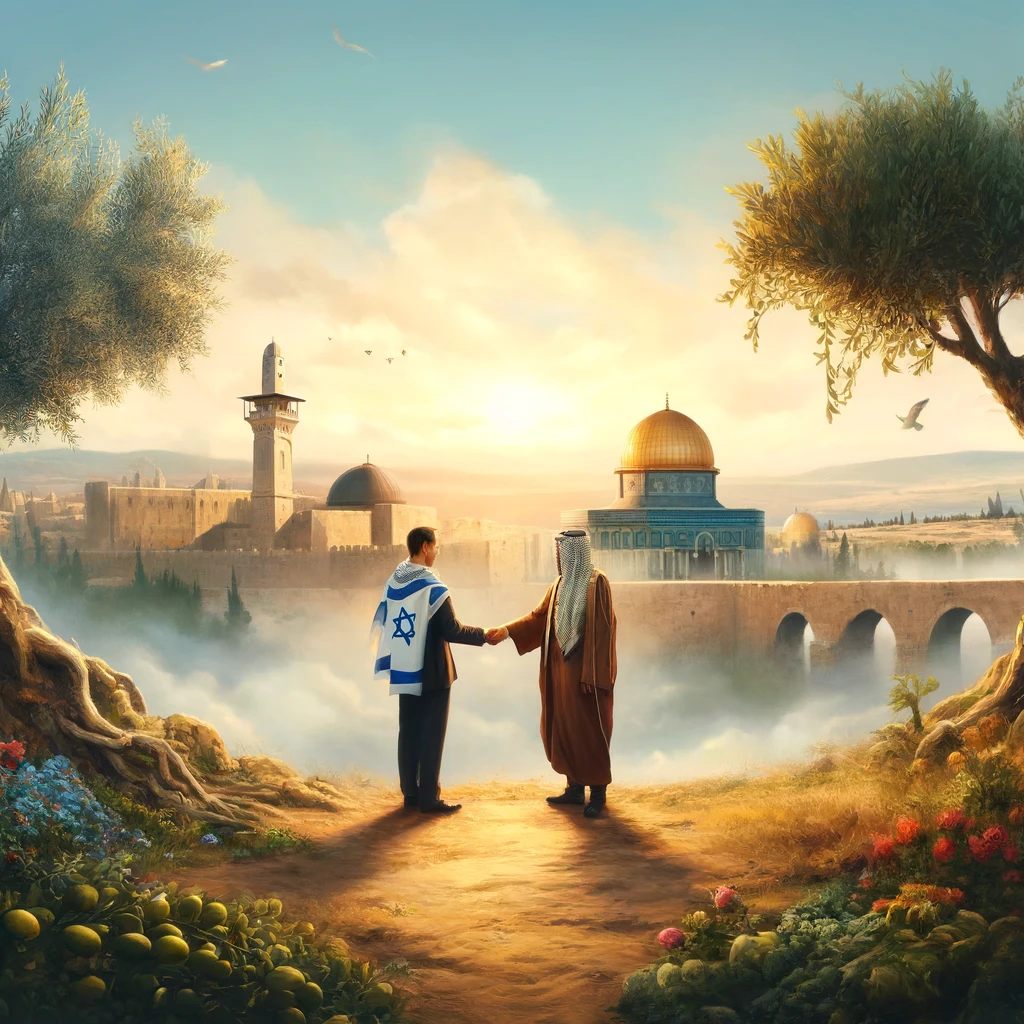
Peace and conflict resolution efforts involving Israel represent one of the most sophisticated, multifaceted, and resilient ecosystems of diplomacy, civil society engagement, scientific collaboration, and humanitarian cooperation in modern geopolitics. While political headlines often focus on periodic escalations, an expansive and enduring network of formal treaties, Track II backchannel dialogues, cross-border medical initiatives, international disaster relief, shared environmental projects, intercontinental economic corridors, and grassroots coexistence models operates continuously beneath the surface.
This comprehensive strategic analysis provides an exhaustive examination of peacebuilding and coexistence in Israel. We analyze the historical arc of formal statecraft—from the historic treaties with Egypt and Jordan to the paradigm-shifting Abraham Accords, the I2U2 coalition, and the India-Middle East-Europe Economic Corridor (IMEC)—alongside Track II diplomacy, medical humanitarian lifelines (such as Save a Child’s Heart, Road to Recovery, and Operation Good Neighbor), global disaster response (IsraAID), scientific peacemaking (SESAME Synchrotron), shared society educational frameworks (Hand in Hand and Neve Shalom), moral reconciliation movements (Parents Circle-Families Forum and Women Wage Peace), transboundary environmental peacemaking (EcoPeace and the Arava Institute), economic innovation corridors, and interfaith reconciliation networks.
1. The Strategic Continuum: From Bilateral Treaties to Regional Integration
Formal peace architecture in the Middle East has undergone a profound evolution over the past half-century. Peacemaking has transitioned from traditional “land-for-peace” bilateral armistices into warm, multi-dimensional regional integration based on shared security interests, technological synergy, and economic interdependence.
| Peace Accord / Framework | Signatory Parties | Year Signed | Strategic Significance & Key Pillars |
|---|---|---|---|
| Camp David Accords / Egypt-Israel Peace Treaty | Israel & Egypt (Menachem Begin, Anwar Sadat, Jimmy Carter) | 1979 | First Arab-Israeli peace treaty; complete Israeli withdrawal from Sinai; demilitarization verified by MFO; foundation of regional security and energy cooperation (QIZ, offshore gas). |
| Treaty of Peace Between Israel and Jordan | Israel & Jordan (Yitzhak Rabin, King Hussein, Bill Clinton) | 1994 | International border demarcation; Israel guarantees 50+ million m³ of water annually to Amman; joint Jordan Valley security; special Jordanian status over Jerusalem Holy Sites. |
| The Abraham Accords | Israel, United Arab Emirates, Bahrain, Morocco, Sudan | 2020 | Historic regional normalization; direct flights; mutual embassies; bilateral CEPA free trade; trilateral water-energy pacts; joint high-tech R&D funds and academic exchanges. |
| The Negev Forum & I2U2 Coalition | Israel, USA, UAE, Bahrain, Egypt, Morocco, India | 2022 | Multilateral working groups advancing regional food security, clean tech, public health, counter-terrorism, and inter-continental trade corridors. |
| IMEC (India-Middle East-Europe Corridor) | India, UAE, Saudi Arabia, Jordan, Israel, EU, USA | 2023 | Transcontinental multimodal trade route linking Mumbai to Haifa Port and Europe via rail, clean hydrogen pipelines, and high-speed fiber cables. |
The 1979 Egypt-Israel Peace Treaty: The Cornerstone of Stability
Brokered at Camp David by U.S. President Jimmy Carter, the historic peace treaty signed between Israeli Prime Minister Menachem Begin and Egyptian President Anwar Sadat fundamentally transformed Middle Eastern geopolitics. In exchange for full diplomatic recognition, trade relations, and open borders, Israel evacuated the entire Sinai Peninsula, dismantled its settlements, and returned the strategic oil fields of the Gulf of Suez.
To guarantee long-term compliance, the treaty established the Multinational Force and Observers (MFO), an independent international peacekeeping body that has successfully monitored the demilitarized Sinai zones for over four decades. Furthermore, economic cooperation was institutionalized through Qualifying Industrial Zones (QIZ) in Egypt, allowing duty-free exports to the United States for Egyptian manufactured goods containing Israeli inputs, generating hundreds of thousands of Egyptian manufacturing jobs and over $1 billion in annual exports.
The 1994 Israel-Jordan Peace Treaty: The Hydro-Security Alliance
Signed at the southern border crossing of Wadi Araba by Israeli Prime Minister Yitzhak Rabin and Jordan’s King Hussein, the 1994 treaty codified a vital strategic partnership. Beyond demarcating the international boundary and opening border crossings, the treaty made historic provisions for shared water resources: Israel committed to transferring tens of millions of cubic meters of fresh water annually from the Sea of Galilee and desalination networks to parched Jordan, while Jordan coordinates closely with Israel on border defense and regional counter-terrorism along the 300-kilometer Jordan River frontier.
The Paradigm Shift of the Abraham Accords
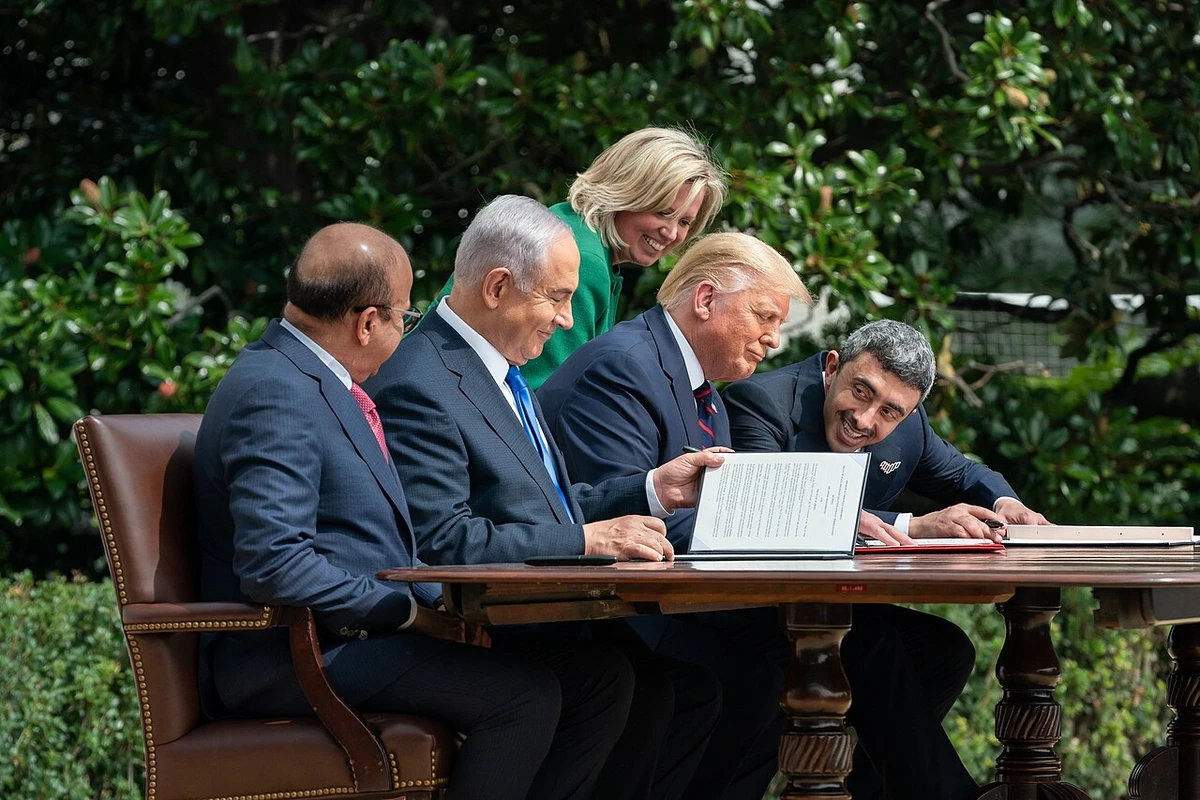
Signed in September 2020 on the South Lawn of the White House, the Abraham Accords shattered decades of conventional diplomatic doctrine which held that regional normalization could only occur following the final resolution of the Israeli-Palestinian conflict. By establishing full diplomatic, commercial, and tourism ties between Israel and the UAE, Bahrain, Morocco, and Sudan, the accords established a “warm peace” model characterized by:
- Bilateral Free Trade & Investment: Comprehensive free trade agreements (such as the Israel-UAE Comprehensive Economic Partnership Agreement – CEPA) reducing tariffs on 96% of goods and generating over $3 billion in annual non-defense bilateral trade.
- Aviation & Tourism Corridors: Hundreds of direct commercial flights weekly connecting Ben Gurion Airport with Dubai, Abu Dhabi, Manama, Marrakech, and Casablanca, facilitating interpersonal connections, academic conferences, and cultural exchanges among over one million regional travelers.
- Trilateral Strategic Infrastructure: Initiatives such as Project Prosperity, a landmark trilateral agreement brokered between Israel, Jordan, and the UAE, under which Jordan constructs 600 MW of solar capacity in its desert to export clean electricity to Israel, in exchange for Israel desalinating and piping 200 million cubic meters of fresh water annually back to parched Jordan.
The I2U2 Group & IMEC Intercontinental Vision
The strategic momentum of regional peace expanded globally through multilateral mini-lateral coalitions:
- The I2U2 Coalition (Israel, India, UAE, USA): Established in 2022 to leverage private-sector capital and technological expertise for global infrastructure. Key projects include a $2 billion investment in integrated agricultural food parks across India utilizing Israeli precision drip irrigation and seed genetics, backed by UAE sovereign financing.
- The India-Middle East-Europe Economic Corridor (IMEC): Unveiled at the G20 New Delhi summit, IMEC represents a transformative geopolitical connectivity corridor. The network integrates railway and shipping routes linking India to the Arabian Gulf, transiting across Jordan to Israel’s Mediterranean Port of Haifa, and connecting directly to mainland Europe. IMEC reduces transit times between India and Europe by 40% and integrates clean hydrogen pipelines and digital data cables along its entire length.
2. Track II Diplomacy: The Power of Backchannels and Civil Think Tanks
While official Track I diplomacy is conducted by government ministers and state diplomats, Track II diplomacy refers to unofficial, non-binding dialogues conducted by academics, retired security officials, policy experts, and civil society leaders. Track II processes provide a confidential, risk-free environment to test innovative solutions, build personal trust, and design actionable frameworks that can later be adopted by formal decision-makers.
The Peres Center for Peace and Innovation
Founded in 1996 by Nobel Peace Prize laureate and former Israeli President Shimon Peres, the Peres Center for Peace and Innovation in Jaffa is one of the Middle East’s flagship institutions dedicated to conflict resolution through tangible collaboration. The center operates extensive cross-border programs spanning:
- Medical Cooperation: Training Palestinian doctors and pediatric specialists in top Israeli teaching hospitals to build long-term medical capacity in the West Bank and Gaza.
- Sport for Peace: The Twinned Peace Sports Schools program, uniting thousands of Jewish and Arab boys and girls annually through joint soccer, basketball, and judo training camps.
- Business & Tech Incubation: Mentoring Israeli and Palestinian tech entrepreneurs, facilitating angel investments, and organizing cross-border hackathons.
The Geneva Initiative & Policy Simulation Hubs
The Geneva Initiative (drafted in 2003 by former Israeli minister Yossi Beilin and former Palestinian Authority minister Yasser Abed Rabbo) stands as the most detailed Track II model for a comprehensive permanent status agreement, offering exhaustive annexes addressing border demarcations, security guarantees, water allocation, and Jerusalem municipal governance.
| Track Level | Primary Actors | Operational Mechanism | Core Objective |
|---|---|---|---|
| Track I (Official) | Heads of State, Foreign Ministries, Military Commanders | Bilateral summits, binding legal treaties, security coordination | Formal cessation of hostilities, mutual diplomatic recognition, legal border demarcation. |
| Track 1.5 (Hybrid) | Former diplomats, intelligence advisers, trusted emissaries | Unofficial backchannels with direct executive access | Testing policy compromises without political risk for sitting governments. |
| Track II (Unofficial) | Think tanks, university professors, retired generals, NGO leaders | Academic workshops, joint working groups, confidential policy drafting | Building interpersonal trust, humanizing the “other,” modeling creative treaty annexes. |
| Track III (Grassroots) | Civic activists, youth, medical volunteers, educators, artists | Bilingual schooling, medical transport, joint musical choirs, sports camps | Eradicating prejudice, fostering organic social empathy, sustaining shared everyday life. |
3. Cross-Border Medical Humanitarian Diplomacy
Nowhere is the profound human dimension of coexistence more evident than in Israel’s cross-border healthcare initiatives. Israeli hospitals, doctors, and volunteer networks provide thousands of life-saving medical treatments to regional neighbors regardless of geopolitical conflict.
Save a Child’s Heart (SACH)
Founded in 1995 at the Wolfson Medical Center in Holon by the late Dr. Amram Cohen, Save a Child’s Heart (SACH) is an internationally acclaimed Israeli humanitarian organization holding Special Consultative Status with the United Nations. SACH provides free, life-saving cardiac surgeries and catheterizations to children suffering from congenital and rheumatic heart diseases from developing nations across the globe.
Key SACH Achievements:
- Over 6,500 Children Treated: Life-saving pediatric heart surgeries performed for children from 68 countries, including the Palestinian Authority, Gaza, Syria, Iraq, Jordan, Ethiopia, Tanzania, Zanzibar, Ukraine, and Vietnam.
- Free Weekly Pediatric Clinics: Over 50% of the children treated annually are Palestinian children from the West Bank and Gaza who attend weekly diagnostic cardiology clinics at Wolfson Medical Center.
- Medical Capacity Building: Fully funded training of over 150 international surgeons, cardiologists, perfusionists, and ICU nurses at Wolfson to establish independent pediatric cardiac centers in their home countries.
Road to Recovery (Derech Hachlama)
Founded in 2010 by Yuval Roth (an Israeli bereaved brother who lost his sibling in the conflict), Road to Recovery (Derech Hachlama) is an extraordinary grassroots volunteer association comprised of over 1,200 Israeli citizen drivers.
Every day, these Israeli volunteers wake up at dawn to drive their personal cars to security crossing checkpoints along the West Bank and Gaza borders. They pick up Palestinian patients—predominantly children battling cancer, kidney failure, or rare organ conditions requiring specialized tertiary care—and transport them safely and compassionately to Israeli hospitals (such as Rambam, Sheba, and Hadassah), and return them to the checkpoint in the evening. In an average year, Road to Recovery coordinates more than 20,000 patient transport journeys covering over 1.2 million kilometers entirely on a voluntary basis.
Operation Good Neighbor & Syrian Cross-Border Aid
Between 2016 and 2018, during the height of the Syrian Civil War, the Israel Defense Forces launched Operation Good Neighbor (Mivtza Shachen Tov) along the Golan border. Israeli medical corps treated more than 4,000 wounded Syrian men, women, and children in Israeli civilian hospitals (including Ziv Medical Center in Safed and Galilee Medical Center in Nahariya), delivered hundreds of tons of food, medical supplies, fuel, and clothing, and established a field clinic directly on the border to provide ongoing maternal and pediatric primary care to desperate Syrian civilians.
IsraAID: Global Humanitarian and Disaster Relief
Founded in 2001, IsraAID is Israel’s flagship non-governmental humanitarian aid agency. Deploying rapidly to global disaster zones, IsraAID provides emergency medical relief, psychological trauma support (MHPSS), clean water systems, and long-term community rehabilitation. IsraAID has operated in over 55 nations, providing urgent disaster response following earthquakes in Haiti, Nepal, and Turkey, hurricanes in the United States and Caribbean, refugee support in Greece and Germany, and wartime civilian humanitarian aid in Ukraine.
The Dream Doctors Project: Medical Clowning Diplomacy
Pioneered in Israeli tertiary hospitals, the Dream Doctors Project integrates professional therapeutic clowns into specialized pediatric oncology, trauma, and burn units. Beyond domestic hospitals, Israeli Dream Doctors have deployed alongside IDF humanitarian field missions across the globe—from earthquake zones in Nepal and Haiti to refugee intake hubs in Europe—using laughter and emotional connection to alleviate acute psychological pediatric trauma.
4. Grassroots Coexistence & Shared Society
Within the State of Israel, where Arab citizens comprise roughly 21% of the population, numerous organizations work tirelessly to build an integrated, equitable, and cohesive shared society.
Hand in Hand: Center for Jewish-Arab Education in Israel (Yad B’Yad)
Founded in 1998 by Lee Gordon and Amin Khalaf, Hand in Hand (Yad B’Yad) operates a network of seven integrated, bilingual, public schools across Israel—in Jerusalem, Haifa, Tel Aviv-Jaffa, the Galilee, Kfar Saba, and Wadi Ara—educating over 2,000 Jewish and Arab students together.
The Hand in Hand Educational Model:
- Dual-Teacher Pedagogy: Every classroom is co-led by two certified teachers—one Jewish-Israeli and one Arab-Israeli—teaching simultaneously in Hebrew and Arabic.
- Bilingual Fluency & Cultural Symmetry: Students achieve full spoken and written fluency in both Hebrew and Arabic, studying the literature, holidays, history, and narrative heritage of both communities with equal respect.
- Adult Community Engagement: The schools serve as community centers for thousands of Jewish and Arab parents who participate in joint language classes, cultural celebrations, and social action committees.
Neve Shalom / Wahat al-Salam (Oasis of Peace)
Perched on a hilltop midway between Jerusalem and Tel Aviv, Neve Shalom / Wahat al-Salam (“Oasis of Peace”) is a cooperative intentional village founded in 1970 by Father Bruno Hussar. It is the only community in the world where Israeli Jews and Israeli Arabs have chosen to live together as equal neighbors based on shared civic principles.
The village established the renowned School for Peace (SfP), which has trained over 70,000 Israeli, Palestinian, and international professionals, educators, lawyers, and municipal leaders in innovative conflict dialogue methodology, structured asymmetric power analysis, and collaborative civic problem-solving.
Givat Haviva: Center for a Shared Society
Established in 1949 by the Kibbutz Artzi Federation, Givat Haviva is the oldest and most established shared society organization in Israel. Recipient of the UNESCO Prize for Peace Education, Givat Haviva fosters systemic municipal partnerships (such as pairing neighboring Jewish and Arab regional councils), youth leadership academies, and civic advocacy to advance equal opportunities.
5. Bereaved Families & Moral Reconciliation Movements
Some of the most powerful moral voices for reconciliation come from individuals who have suffered the most profound personal losses in the conflict.
The Parents Circle-Families Forum (PCFF)
The Parents Circle-Families Forum is a joint Israeli-Palestinian organization comprising over 600 bereaved families who have lost immediate family members to the conflict. Rather than seeking vengeance, these families dedicate their lives to dialogue, education, and reconciliation. The forum conducts hundreds of joint school lectures annually, operates an international telephone dialogue hotline, and produces the annual Joint Israeli-Palestinian Memorial Day Ceremony, demonstrating that shared grief can be transformed into a powerful catalyst for peace.
Combatants for Peace & Women Wage Peace
- Combatants for Peace: Founded in 2006 by former Israeli soldiers and former Palestinian fighters who renounced armed violence in favor of joint non-violent activism, community dialogue, and public reconciliation tours.
- Women Wage Peace (Nashim Osim Shalom): Established in 2014, this non-partisan grassroots movement unites over 45,000 Israeli women—Jewish, Muslim, Christian, Druze, and Bedouin—alongside Palestinian sister movements to advocate tirelessly for diplomatic negotiations and women’s inclusion in formal peacemaking (in accordance with UN Resolution 1325).
- Tag Meir Coalition: A broad coalition of over 50 civil society and religious organizations dedicated to eradicating hate crimes, protecting vulnerable holy sites, and providing immediate solidarity visits to victims of inter-communal violence.
6. Scientific & Particle Physics Diplomacy: The SESAME Synchrotron
In the realm of fundamental science, Israel participates in historic regional scientific partnerships that transcend political rivalries:
The SESAME Synchrotron Project (Allan, Jordan)
The SESAME (Synchrotron-light for Experimental Science and Applications in the Middle East) laboratory is a state-of-the-art third-generation synchrotron light source located in Allan, Jordan. Developed under the auspices of UNESCO and modeled on CERN in Switzerland, SESAME is jointly operated and funded by an extraordinary coalition of Middle Eastern governments: Israel, Jordan, Egypt, Cyprus, Pakistan, the Palestinian Authority, Iran, and Turkey.
At SESAME, Israeli, Jordanian, Palestinian, Egyptian, and Iranian physicists, crystallographers, and biologists conduct groundbreaking collaborative research using high-intensity X-ray beams to analyze ancient archaeological relics, design new anti-cancer pharmaceuticals, and engineer advanced solar nanomaterials, demonstrating the unshakeable power of scientific inquiry to build regional bridges.
Red Sea Marine Biology Alliances
In the Gulf of Aqaba, the Interuniversity Institute for Marine Sciences in Eilat and the Marine Science Station in Aqaba, Jordan collaborate closely on monitoring coral reef resilience to climate change. Because Red Sea corals possess a unique genetic thermal tolerance that protects them from global bleaching events, this cross-border scientific team shares real-time ecological data to safeguard the entire coral corridor.
7. Environmental Peacemaking: “Nature Knows No Borders”
Ecosystems, aquifers, air currents, and migratory wildlife ignore political borders. In the water-scarce, ecologically sensitive Middle East, transboundary environmental cooperation has proven to be one of the most resilient and pragmatic avenues for regional peacebuilding.
| Environmental Initiative | Transboundary Partners | Core Focus Area | Impact & Key Milestones |
|---|---|---|---|
| EcoPeace Middle East | Israeli, Jordanian & Palestinian environmentalists | Jordan River & Dead Sea rehabilitation; water diplomacy | Pioneered the ‘Water Energy Nexus’ concept leading to the trilateral Project Prosperity agreement. |
| Arava Institute for Environmental Studies | Kibbutz Ketura, Israeli, Arab & International researchers | Desert agriculture, solar tech, transboundary wastewater treatment | Over 1,200 alumni leading regional sustainability projects; deployed off-grid graywater systems across rural villages. |
| Barn Owls for Biological Pest Control | Tel Aviv University, SPNI, Jordanian & Palestinian farmers | Ecological agriculture in the Jordan Rift Valley | Installed over 5,000 nesting boxes, replacing chemical rodenticides with natural owl predation across cross-border farms. |
EcoPeace Middle East: The Water-Energy Nexus
Operating joint offices in Tel Aviv, Amman, and Ramallah, EcoPeace Middle East (formerly Friends of the Earth Middle East) brings together Israeli, Palestinian, and Jordanian environmentalists to protect shared water resources. EcoPeace championed the concept that regional water and renewable energy dependencies can be harnessed to create mutual security: Israel’s world-leading SWRO seawater desalination capacity can supply endless fresh water to Jordan, while Jordan’s vast desert expanses can supply clean solar electricity to Israel and the Palestinian territories.
The Arava Institute at Kibbutz Ketura
Located in the southern Arava Desert, the Arava Institute for Environmental Studies is a premier academic research center operating under the motto “Nature Knows No Borders.” The institute brings together Israelis, Palestinians, Jordanians, Moroccans, and international students for intensive academic study in transboundary water management, renewable energy, and climate adaptation. Alumni of the institute have successfully deployed decentralized off-grid solar-powered wastewater treatment units and atmospheric water generators in underserved rural communities across the region.
8. Economic Peace, Innovation Hubs & High-Tech Inclusion
Economic prosperity and shared technological innovation provide vital foundations for enduring peace. Israeli initiatives focus both on domestic integration of minority communities into the high-tech sector and cross-border commercial partnerships.
Integrating Arab-Israeli Talent: Tsofen, Hasoub, and Moona
The Israeli high-tech sector has actively expanded inclusion initiatives to bridge economic disparities and harness the vast talent pool of Arab-Israeli engineers and computer scientists:
- Tsofen (High Technology in the Arab Community): Founded in 2008 by Jewish and Arab tech executives in Nazareth, Tsofen has helped transform Nazareth into an active high-tech hub, increasing the number of Arab software engineers employed in Israel’s tech sector from barely 350 in 2008 to over 10,000 today.
- Hasoub & KamaTech: Grassroots technological incubators fostering high-growth entrepreneurship, providing intensive coding bootcamps, seed venture capital, and senior executive mentorship to Arab tech founders across the Galilee, the Triangle, and the Negev.
- Moona – A Space for Change: Founded by former IAF pilot Asaf Brimer in the Arab municipality of Majd al-Krum in the Western Galilee, Moona operates cutting-edge technological makerspaces where Jewish, Muslim, Christian, and Druze youth learn robotics, drone technology, AI programming, and 3D industrial printing together in mixed engineering teams.
Cross-Border Software Outsourcing & Regional R&D
Israeli tech giants (including Mellanox/NVIDIA, Microsoft Israel, and Intel Israel) have pioneered software engineering outsourcing to Palestinian tech firms based in Ramallah and Rawabi, creating hundreds of high-wage jobs and establishing peer-to-peer engineering connections across borders.
9. Interfaith Reconciliation, Sports & Cultural Bridges
Given the central spiritual importance of the Holy Land to Judaism, Christianity, and Islam, interfaith dialogue represents a fundamental pillar of grassroots peacebuilding in Israel.
The Elijah Interfaith Institute
Based in Jerusalem, the Elijah Interfaith Institute is a global NGO that convenes top religious leaders—including the Chief Rabbinate of Israel, prominent Muslim Imams, Christian Patriarchs, Cardinals, and Buddhist scholars—to generate theological frameworks for peace, mutual respect, and peaceful coexistence.
Budo for Peace: Martial Arts for Coexistence
Founded by Australian-Israeli Karate champion Danny Hakim, Budo for Peace utilizes traditional Japanese martial arts principles (respect, discipline, harmony, self-control) to bridge cultural divides. The organization operates mixed dojos across Israel where Jewish, Arab, and Bedouin children train together, bow to one another in mutual honor, and practice conflict avoidance techniques.
Good Deeds Day (Yom Ma’asim Tovim)
Founded in Israel in 2007 by businesswoman and philanthropist Shari Arison, Good Deeds Day has evolved into an international civic tradition celebrated in over 110 countries. Across Israel, over two million citizens from all ethnic and religious sectors volunteer simultaneously on a single day—renovating community centers, cleaning nature parks, and assisting vulnerable populations.
Haifa’s Holiday of Holidays (Chag HaChagim)
Every December, the multicultural port city of Haifa hosts the Holiday of Holidays (Chag HaChagim), a vibrant city-wide festival celebrating Hanukkah, Christmas, and Ramadan simultaneously. Centered in the historic Wadi Nisnas and German Colony neighborhoods, the festival draws hundreds of thousands of Jewish, Muslim, Christian, and Druze visitors for joint art exhibitions, culinary tours, musical concerts, and street parades.
Culinary Peacemaking & Cross-Border Kitchens
Food is a powerful vehicle for cultural intimacy in the Middle East. Cooperative culinary initiatives—such as the Galilee Culinary Institute and Jewish-Arab baking collectives in Acre and Jaffa—bring together female home cooks and professional chefs to document shared culinary heritage, publish bilingual cookbooks, and host communal dinners celebrating authentic regional flavors.
The Jerusalem Youth Chorus
Founded in 2012, the Jerusalem Youth Chorus is an internationally acclaimed choral ensemble uniting high school singers from both East and West Jerusalem. Performing in Arabic, Hebrew, and English, the chorus combines rigorous vocal artistry with structured weekly dialogue sessions, demonstrating to global audiences the transformative power of shared harmony.
10. Frequently Asked Questions (FAQ)
What are the Abraham Accords and why are they significant?
Signed in 2020, the Abraham Accords are historic normalization agreements between Israel and four Arab nations: the UAE, Bahrain, Morocco, and Sudan. They established direct diplomatic relations, free trade, direct aviation, and joint high-tech research, creating a regional model of “warm peace.”
What is the India-Middle East-Europe Economic Corridor (IMEC)?
IMEC is a historic multilateral infrastructure corridor linking India, the Arabian Gulf, Jordan, Israel (Port of Haifa), and Europe via rail networks, clean hydrogen pipelines, and high-speed data cables, cutting transit times by 40%.
What is the SESAME project in Jordan?
SESAME is a state-of-the-art synchrotron particle accelerator laboratory in Allan, Jordan, jointly governed and operated by Israel, Jordan, Egypt, Cyprus, Pakistan, the Palestinian Authority, Iran, and Turkey under UNESCO auspices for peaceful scientific research.
How does Save a Child’s Heart contribute to humanitarian peacebuilding?
Save a Child’s Heart (SACH) has provided free, life-saving heart surgeries to more than 6,500 children from 68 developing countries (including over 3,000 Palestinian children) at Wolfson Medical Center in Holon, while training dozens of foreign medical professionals.
What is the mission of Road to Recovery (Derech Hachlama)?
Road to Recovery is a volunteer network of over 1,200 Israeli drivers who voluntarily transport Palestinian patients (mostly children requiring cancer or critical treatment) from border checkpoints to Israeli hospitals and back every day.
What was Operation Good Neighbor (Mivtza Shachen Tov)?
Operation Good Neighbor was an IDF humanitarian mission between 2016 and 2018 that provided medical treatment in Israeli civilian hospitals to over 4,000 wounded Syrian civilians affected by the Syrian Civil War, alongside delivering hundreds of tons of food and medicine.
How do Hand in Hand (Yad B’Yad) schools operate?
Hand in Hand operates bilingual public schools where Jewish and Arab students study together in classrooms co-taught by two teachers—one Jewish and one Arab—achieving fluency in both Hebrew and Arabic with equal cultural respect.
What is the ‘Water Energy Nexus’ in Middle East environmental peacebuilding?
Pioneered by EcoPeace Middle East and realized through Project Prosperity, the Water-Energy Nexus is a trilateral agreement where Jordan generates clean solar power in its deserts for export to Israel, while Israel desalinates and pipes fresh water back to Jordan.