
Ariel Sharon stands as one of the most formidable, charismatic, and transformative figures in the military and political history of modern Israel. As an intrepid commando commander, legendary armored general, Minister of Defense, and the eleventh Prime Minister of Israel, Sharon dedicated over five decades of service to the defense, physical settlement, infrastructure modernization, and strategic repositioning of the Jewish state. Known affectionately as “Arik” and celebrated as “the King of Israel” by his troops, Sharon was the tactical mastermind of the 1967 Abu Ageila breakthrough and the decisive 1973 Suez Canal crossing. Later, as Prime Minister, he demonstrated extraordinary political courage by defeating terrorism during Operation Defensive Shield, constructing the West Bank Security Barrier, executing the 2005 Gaza Disengagement, and shattering decades of ideological polarization by creating the centrist Kadima party.
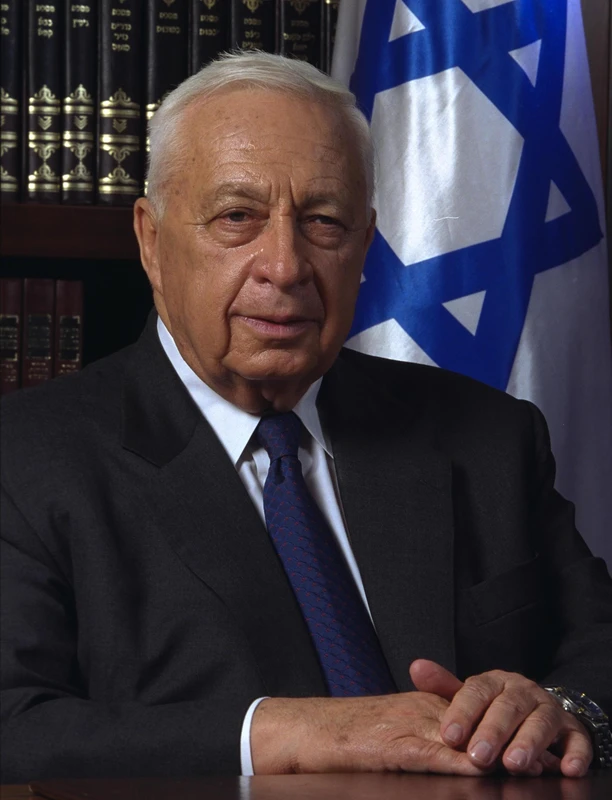
(via Wikimedia Commons, CC BY-SA 3.0).
Official portrait of Prime Minister Ariel Sharon, eleventh Prime Minister of Israel, renowned armored warfare commander, and founder of the Kadima party.
Executive Takeaways: Military Genius, Pragmatism & Political Realignment
- Military Mastermind of Abu Ageila & Suez: Engineered the classic combined-arms breakthrough at Abu Ageila in 1967 and commanded the historic Suez Canal crossing (Operation Stouthearted Men) in 1973, altering the course of Middle Eastern history.
- Founder of Unit 101: In 1953, established the elite commando Unit 101, pioneering night fighting, small-unit raiding, and the IDF’s culture of fearless offensive initiative.
- Restoring Security Deterrence (2002): As Prime Minister, authorized Operation Defensive Shield, decisively suppressing suicide terrorism and pioneering urban counter-terrorism doctrines.
- The West Bank Security Barrier: Constructed the multi-layered anti-terror security fence, reducing suicide bombings inside Israeli cities by over 95%.
- Political Realignment & Kadima (2005): Executed the unilateral Gaza Disengagement plan and founded the centrist Kadima party, creating a new political consensus focused on pragmatic security borders.
1. Early Life, Pioneering Roots in Kfar Malal, and the 1948 War
Born Ariel Scheinermann on February 26, 1928, in the cooperative agricultural village of Kfar Malal in the Sharon plain, Sharon grew up in an austere, fiercely independent household. His parents, Shmuel Scheinermann and Vera (Dvora) Schneeroff, were highly educated agronomists who had fled the Bolshevik Revolution in Russia. In Kfar Malal, the Scheinermann family often stood apart from their collectivist neighbors due to their individualistic outlook and refusal to conform to communal socialist orthodoxy. From his father, Sharon inherited a deep scientific understanding of botany, soil management, and agriculture, alongside a lifelong love for the physical land.
At age fourteen, Sharon joined the Haganah underground, patrolling the orchards and perimeter fences of Kfar Malal with an iron-tipped wooden club and later a British rifle. He graduated from the Geula High School in Tel Aviv in 1945 and immediately enrolled in Haganah commanders’ courses.
During the 1948 War of Independence, Sharon served as a platoon commander in the Alexandroni Brigade. In May 1948, during the bloody First Battle of Latrun against the Transjordanian Arab Legion, Sharon was severely wounded in the abdomen and leg while leading his men through heavy machine-gun fire. Pinned down in the scorching wheat fields as Jordanian soldiers advanced, Sharon was saved by a sixteen-year-old soldier, Yaakov Bugov, who dragged him to safety. The agony of Latrun left an indelible impression on Sharon: he resolved that he would never leave wounded comrades on the battlefield and would never accept defeat.
2. Unit 101, Paratroop Command, and the Mitla Pass (1953–1956)
In the early 1950s, Israel faced a wave of cross-border Fedayeen infiltrations from Egyptian-controlled Gaza and Jordanian-controlled West Bank, resulting in hundreds of civilian casualties. The conventional IDF of the era struggled to counter small-unit night infiltrations.
In August 1953, Prime Minister David Ben-Gurion and Chief of Staff Moshe Dayan summoned Sharon—then a 25-year-old student of history and Middle Eastern studies at the Hebrew University—and tasked him with creating an elite commando unit: Unit 101. Sharon recruited a band of audacious kibbutzniks, trackers, and rugged fighters, training them in extreme endurance, live-fire room clearing, nocturnal navigation, and deep-penetration raiding.
Unit 101 transformed the IDF’s operational psychology from passive border defense to aggressive retaliatory strikes inside enemy territory. When Unit 101 merged with the 890th Paratroop Battalion in 1954 under Sharon’s command, the Paratroopers became the elite vanguard of the IDF, setting the combat standard for the entire military.
During the 1956 Sinai Campaign (Operation Kadesh), Colonel Sharon commanded the 202nd Paratroop Brigade. Following a daring drop at the eastern mouth of the Mitla Pass, Sharon led his forces through the heavily fortified Egyptian gorge (Heitan Defile) in a fierce, brutal battle, securing the central Sinai axis and demonstrating relentless combat tenacity.

(via Wikimedia Commons, Creative Commons / Public Domain).
Prime Minister Ariel Sharon conferring with US President George W. Bush at the Prairie Chapel Ranch in Crawford, Texas, securing the historic 2004 US letter of strategic guarantees.
3. Abu Ageila (1967): The Masterpiece of Combined-Arms Armor Warfare
In June 1967, Major General Ariel Sharon commanded the 38th Armored Division on the central Sinai front. Facing the formidable Egyptian fortified complex at Abu Ageila–Umm Katef—a deeply entrenched redoubt protected by triple trench lines, minefields, 90 tanks, and heavy artillery—Sharon designed and executed what military historians consider one of the most brilliant combined-arms night battles in modern history.
Sharon orchestrated a synchronized assault under cover of darkness:
- Frontal armor pinning forces distracted Egyptian defenders while artillery laid down a massive concentrated barrage.
- Helicopter-borne paratroopers landed behind enemy lines in the dark, marching through sand dunes to assault and neutralize Egyptian artillery batteries.
- Armored combat engineers cleared a narrow pathway through deep minefields, while infantry battalions cleared the triple trench lines in hand-to-hand combat using colored flashlight identification.
- Sharon’s main armored column surged through the breach, shattering the Egyptian defensive line from the rear.
The battle was won in under twelve hours with minimal Israeli casualties, opening the central roadway across Sinai and allowing IDF armor to race toward the Suez Canal. Sharon’s victory at Abu Ageila is taught to this day at West Point and military staff colleges worldwide as a classic study in synchronization, tactical deception, and night warfare.
4. The 1973 Yom Kippur War: Operation Stouthearted Men and Crossing the Suez
Having retired from the IDF in July 1973 to help co-found the Likud political bloc, Sharon was urgently recalled to active duty on October 6, 1973, following the surprise Egyptian-Syrian invasion. Appointed commander of the 143rd Reserve Armored Division on the Sinai front, Sharon immediately recognized that static defense along the canal was futile; only an aggressive offensive crossing into the Egyptian mainland could shatter the enemy’s momentum.
On the night of October 15–16, 1973, Sharon executed Operation Stouthearted Men (Abirey Lev). Identifying an unfortified seam between the Egyptian Second and Third Armies at the Deversoir near the Great Bitter Lake, Sharon’s division punched through the Chinese Farm in one of the most savage armored battles in history.
Operating with a bandage wrapped around his head after suffering a shrapnel wound, Sharon established a pontoon bridgehead across the Suez Canal. His armored brigades crossed onto the western bank of the canal, destroying dozens of Egyptian surface-to-air missile (SAM) batteries. This allowed the Israeli Air Force to regain total air superiority over the battlefield. Sharon’s forces advanced southwest, cutting the Cairo-Suez highway and completely encircling the Egyptian Third Army (comprising 30,000 troops and 300 tanks).
Sharon’s Suez crossing transformed an imminent strategic catastrophe into a triumphant military victory, forcing Egypt to agree to immediate ceasefire talks and paving the way for the 1974–1975 disengagement agreements.

(via Wikimedia Commons, Creative Commons / Public Domain).
Prime Minister Ariel Sharon addressing the Knesset in Jerusalem during a major policy debate on national security and regional disengagement.
5. Minister of Housing: Absorbing One Million Soviet Immigrants (1990–1992)
In 1990, as Minister of Housing and Construction in Yitzhak Shamir’s government, Sharon undertook one of the greatest civilian logistical challenges in Israeli history: absorbing nearly one million Jewish immigrants arriving from the collapsed Soviet Union.
Cutting through immense bureaucratic red tape with his characteristic executive force, Sharon launched a nationwide construction blitz. Under his direction:
- Constructed over 140,000 modern permanent residential apartments in under two years.
- Expanded new residential neighborhoods and development towns across the Galilee, Negev, and coastal plain (including Ashdod, Ashkelon, Beersheba, and Netanya).
- Imported thousands of prefabricated modular homes to ensure no immigrant family was left homeless during the peak influx.
Sharon’s extraordinary housing mobilization prevented a catastrophic humanitarian crisis and successfully integrated hundreds of thousands of Russian-speaking scientists, engineers, physicians, and musicians into the mainstream of Israeli economic and cultural life.
6. Prime Minister (2001–2006): Operation Defensive Shield and the Security Fence
In February 2001, in the midst of the violent Second Intifada, Ariel Sharon was elected Prime Minister of Israel in a landslide victory, winning over 62% of the national vote.
Following the devastating Park Hotel Passover massacre in Netanya in March 2002, which claimed thirty innocent civilian lives, Sharon authorized Operation Defensive Shield (Mivtza Chomat Magen). The IDF mobilized 30,000 reserve soldiers, entering West Bank cities (Jenin, Nablus, Ramallah, Bethlehem) to systematically dismantle bomb laboratories and terrorist networks. The operation fundamentally broke the terrorist infrastructure and restored Israel’s freedom of operational action.
To provide permanent security for Israeli civilians, Sharon initiated the construction of the West Bank Security Barrier—a comprehensive system of electronic fencing, concrete anti-sniper walls, and surveillance sensors. Within three years of its construction, suicide bombing attacks against Israeli urban centers dropped by more than 95%, saving thousands of lives.
7. The 2005 Gaza Disengagement and the Founding of Kadima
In December 2003, at the Herzliya Conference, Sharon stunned the political establishment by announcing his Unilateral Disengagement Plan. Recognizing that maintaining a military occupation inside the densely populated Gaza Strip placed an unbearable burden on IDF soldiers and compromised Israel’s long-term demographic and democratic character, Sharon resolved to withdraw all Israeli civilian settlements and military forces from Gaza and four isolated settlements in northern Samaria.
In August 2005, Sharon executed the disengagement with remarkable logistical discipline, relocating over 9,000 residents while preserving civil peace. In exchange for the withdrawal, Sharon secured a historic letter of strategic guarantees from US President George W. Bush in April 2004, explicitly acknowledging that major Israeli settlement blocs would remain part of Israel in any future permanent status agreement and that Palestinian refugees would be resettled in a Palestinian state rather than within Israel.
In November 2005, refusing to allow right-wing ideologues to paralyze national policy, Sharon broke away from Likud to establish Kadima (Forward)—a centrist political movement uniting pragmatists from Likud (including Ehud Olmert and Tzipi Livni) and Labor (including Shimon Peres and Haim Ramon). Kadima redefined Israeli politics, creating a dominant centrist coalition dedicated to secure, defensible borders and socioeconomic modernization.
8. Comprehensive Overview of Ariel Sharon’s Historic Career
11. The Bush-Sharon Strategic Partnership: The Crawford Summit and Security Guarantees
The personal and strategic relationship between Prime Minister Ariel Sharon and US President George W. Bush represented one of the closest and most productive bilateral partnerships in the history of US-Israel relations. Meeting at the White House and at Bush’s private ranch in Crawford, Texas, the two leaders developed a profound mutual trust grounded in their shared determination to combat global terrorism following the September 11 attacks.
On April 14, 2004, President Bush handed Sharon a historic, formal letter of American commitments that permanently transformed the diplomatic landscape of the Arab-Israeli conflict. In the letter, the United States formally recognized:
- It is unrealistic to expect that the outcome of final status negotiations will be a full return to the 1949 armistice lines (pre-1967 borders), acknowledging established Israeli population centers in Judea and Samaria.
- Any resolution of the Palestinian refugee issue must occur through resettlement in a future Palestinian state rather than within the sovereign borders of the State of Israel.
- Israel retains the inherent sovereign right to defend itself against terrorism and maintain defensible borders.
Sharon’s statesmanship secured for Israel the most robust diplomatic and strategic backing ever granted by an American administration, providing a durable diplomatic anchor for Israel’s strategic doctrine.
12. Strategic Command Ethics, Leadership under Fire, and Combat Innovation
Throughout his military career, Ariel Sharon personified the principle of aggressive operational leadership under fire. Sharon rejected the passive management of battles from distant rear command bunkers; he consistently positioned his command half-track or armored personnel carrier at the very point of main effort, directly behind the leading company commanders.
This proximity to combat enabled Sharon to read the battlefield in real time, sensing moments of enemy confusion, psychological collapse, and tactical opportunity that headquarters maps could never convey. His commanders knew that Sharon would always support aggressive, innovative action, even when it contradicted rigid battle plans.
Sharon was also a brilliant innovator in military logistics. During the 1973 Suez crossing, Sharon mobilized specialized heavy engineering units to construct the “Roller Bridge” (Gesher HaGlaylim) and amphibious Gillois ferries under relentless artillery fire, executing the complex transfer of hundreds of heavy main battle tanks across an international waterway in under 24 hours. His tactical and operational genius fundamentally rewrote the textbooks of modern armored warfare.
13. The Yom Kippur War: Armor Breakthrough and The Battle of the Chinese Farm
The tactical climax of Ariel Sharon’s military career occurred during the epic Battle of the Chinese Farm (HaChava HaSinik) on October 15–17, 1973. Named for an Egyptian agricultural experimental station with Japanese irrigation equipment misidentified as Chinese characters, the location was heavily fortified by the Egyptian 16th Infantry and 21st Armored Divisions with hundreds of anti-tank missile teams and T-62 tanks.
Sharon’s 143rd Division was assigned the mission of opening a narrow corridor along the “Akavish” and “Tirtur” roads to allow bridging equipment to reach the Suez Canal. Sharon committed his paratroop battalions and armored brigades under Colonel Amnon Reshef and Colonel Danny Matt into continuous 36-hour hand-to-hand combat amidst burning armor and relentless missile salvos.
Despite horrific casualties and extreme operational exhaustion, Sharon’s unyielding command opened the corridor on the night of October 16. Matt’s paratroopers crossed the canal on rubber boats, establishing the initial bridgehead on Egyptian soil. Sharon’s tactical audacity at the Chinese Farm broke the back of Egyptian resistance and made the encirclement of the Third Army possible, permanently altering the outcome of the war.
14. Infrastructure Architect: Highway 6, Seaports, and Regional Modernization
In addition to his housing achievements, Ariel Sharon served as Minister of National Infrastructure (1996–1998) and Minister of Foreign Affairs (1998–1999) under Benjamin Netanyahu. In these executive roles, Sharon applied his grand strategic vision to Israel’s physical geography and energy security.
Sharon championed the expansion of the Cross-Israel Highway (Route 6), the construction of the deep-water port terminals in Ashdod and Haifa (the Carmel and Jubilee ports), and the privatization and expansion of natural gas exploration off Israel’s Mediterranean coastline. He understood that a small state requires hyper-efficient transportation arteries and independent energy infrastructure to support rapid demographic and industrial expansion.
During the 1998 Wye River Plantation negotiations in Maryland, Sharon played a pivotal role as Foreign Minister, demanding ironclad security reciprocity from the Palestinian Authority while protecting vital Israeli water sources and strategic high ground in the Jordan Valley.
15. The Historic Shift to the Political Center: The Genesis of Kadima
The founding of the Kadima party in November 2005 was the political masterpiece of Sharon’s final years. For three decades, Israeli politics had been paralyzed by a rigid 50-50 division between the Labor left and Likud right. Sharon recognized that the vast majority of the Israeli public rejected both ideological extremes: they wanted an uncompromising defense against terrorism and defensible borders, combined with a pragmatic willingness to separate from Palestinian population centers to preserve Israel as a Jewish and democratic state.
By pulling the political center of gravity toward Kadima, Sharon created a dominant centrist consensus that governed Israel for years under Ehud Olmert and Tzipi Livni. His bold realignment proved that national security and pragmatic statecraft could unite the nation across traditional ideological chasms.
16. Southern Command & The 1971 Gaza Counter-Terror Campaign
In 1969, Ariel Sharon was appointed General Officer Commanding Southern Command (Aluf Pikud Darom). At the time, the Gaza Strip was gripped by rampant urban terrorism led by the PLO, with civilian grenade attacks, assassinations of local municipal workers, and complete lawlessness paralyzing the refugee camps of Jabalia, Shati, and Khan Yunis.
Sharon designed a groundbreaking, high-intensity counter-insurgency doctrine that pacified the Gaza Strip in under seven months. Sharon established the elite disguised commando unit Sayeret Shaked, deploying small teams disguised as local fishermen and merchants to gather human intelligence and ambush terror cells in their hideouts.
Simultaneously, Sharon widened narrow alleys inside refugee camps into paved avenues, allowing armored patrols to navigate freely and preventing terrorists from operating with impunity. By late 1971, terrorism in Gaza was crushed, commerce resumed, and thousands of Gaza residents traveled safely to daily jobs in Israel, ushering in a decade of unprecedented civilian tranquility and economic growth.
17. The 1982 Lebanon Campaign and Objective Historiographical Assessment
In June 1982, as Minister of Defense under Menachem Begin, Ariel Sharon directed Operation Peace for Galilee. The strategic objective was to eradicate the PLO’s “state-within-a-state” in southern Lebanon, which had subjected northern Israeli Galilean towns (such as Kiryat Shmona and Nahariya) to relentless Katyusha rocket barrages and cross-border massacres (such as the Coastal Road massacre and Misgav Am attack).
Sharon orchestrated a brilliant combined-arms operational advance: the Israeli Air Force destroyed 19 Syrian surface-to-air missile batteries in the Bekaa Valley and shot down 82 Syrian MiG fighters without a single Israeli loss in Operation Mole Cricket 19, while IDF armored and amphibious forces surrounded Beirut. The campaign succeeded in expelling Yasser Arafat and 14,000 PLO fighters from Lebanon to Tunisia, eliminating the conventional cross-border terrorist threat for over a decade.
Following the tragic Sabra and Shatila massacre perpetrated by Lebanese Christian Phalangist militias in September 1982, the Israeli government established the independent Kahan Commission of Inquiry. The commission fully exonerated the IDF of direct responsibility while finding that Sharon bore indirect responsibility for failing to anticipate Phalangist actions. Sharon resigned as Defense Minister, remaining in cabinet as Minister without Portfolio and later rebuilding his political standing through monumental achievements in housing and national infrastructure.
18. Strategic Regional Security Cooperation with Jordan and Egypt
As Prime Minister, Sharon was a staunch champion of regional strategic cooperation with Jordan’s King Abdullah II and Egyptian President Hosni Mubarak. Recognizing that regional stability required close coordination against radical extremist factions, Sharon established regular direct lines of communication with Amman and Cairo.
Sharon expanded the supply of fresh water from the Sea of Galilee to the Hashemite Kingdom of Jordan beyond treaty obligations, provided intelligence assistance to secure joint border security, and concluded the Qualified Industrial Zones (QIZ) trade agreements linking Israeli, Jordanian, and Egyptian manufacturing into duty-free exports to the United States.
His statesmanlike pragmatism proved that strong, unyielding defense posture was entirely compatible with deep, constructive regional partnerships that enhanced the economic prosperity and security of the entire Middle East.
19. Agricultural Mastermind & The Negev Settlement Blueprint
Throughout his political life, Ariel Sharon was the foremost champion of populating and cultivating the Negev and Galilee. As Minister of Agriculture and head of the Ministerial Committee for Settlement in the late 1970s, Sharon designed the “Lookout Settlements” (Mitzpim) plan in the Galilee, establishing dozens of small cooperative communities on rocky mountain ridges to preserve state land and encourage ecological farming.
Sharon also championed the “Seven Stars” (Kochav Yair) development corridor along the Green Line, founding thriving modern towns such as Modi’in, Shoham, and Kochav Yair that connected Tel Aviv to Jerusalem and provided high-quality residential housing for tens of thousands of young families.
20. Economic Modernization and High-Tech Integration Under Sharon
As Prime Minister (2001–2006), Ariel Sharon oversaw the structural transformation of Israel’s economy during a period of severe global recession following the dot-com crash. Working closely with Finance Minister Benjamin Netanyahu, Sharon provided executive backing for far-reaching economic reforms:
- Drastically reduced government spending, lowered corporate and individual income tax rates, and restructured public welfare programs to incentivize workforce participation.
- Privatized state monopolies, including the national airline El Al, the telecommunications company Bezeq, and major banking institutions (Bank Leumi and Discount Bank).
- Expanded state venture capital incubation, positioning Israel’s cybersecurity, medical device, and software sectors for unprecedented global investment and export growth.
These courageous economic reforms transformed Israel into a dynamic free-market economy, achieving consistent GDP growth rates exceeding 5% annually and laying the foundation for two decades of high-tech prosperity.
21. The Legacy of “Arik”: A Nation’s Defender and Sovereign Architect
Ariel Sharon’s life was an epic mirror of the State of Israel’s modern history. From the blood-soaked wheat fields of Latrun in 1948 to the sandy corridors of the Suez Canal in 1973, and from the cabinet tables in Jerusalem to the ranch summits in Texas, Sharon was driven by a single, burning purpose: ensuring the physical survival, strategic invulnerability, and flourishing renaissance of the Jewish people in their ancestral homeland.
His ability to evolve from a relentless battlefield warrior into a pragmatic, courageous statesman capable of making wrenching decisions for the national good earned him the enduring admiration of allies and adversaries alike. Ariel Sharon remains one of the greatest military commanders and sovereign leaders ever produced by the Jewish nation.
22. Command Philosophy: Direct Tactical Leadership & Moral Courage
Ariel Sharon’s command philosophy was characterized by absolute personal physical courage, tactical flexibility, and an insistence on moral integrity in operational reporting. Sharon believed that military commanders must never deceive themselves or their superiors with rosy battlefield reports, famously establishing a standard of brutal honesty during post-mission debriefings.
He maintained that battles are won not by static defensive fortifications, but by fluid maneuver, psychological deception, and breaking the enemy’s will to fight. Sharon’s tactical precepts—such as bypassing enemy strongpoints to strike command nodes and logistics hubs—remain core doctrines taught to IDF armored and commando commanders across all branches of service.
His soldiers loved him because they knew he shared every hardship with them on the front line, ate the same rations, slept in the same dust, and placed his life on the line alongside them in every engagement.
23. The Strategic Water Vision: Desalination and Desert Reforestation
During his tenure as Prime Minister, Ariel Sharon recognized that chronic freshwater scarcity in the Middle East was an existential threat to national security and regional peace. In 2001, Sharon established the National Master Plan for Desalination, directing the rapid construction of massive seawater reverse osmosis (SWRO) plants along the Mediterranean coast, beginning with the Ashkelon and Hadera desalination facilities.
Sharon’s visionary infrastructure plan transformed Israel from a water-scarce nation into a water superpower, producing over 85% of domestic municipal water from the sea and allowing Israel to export surplus water to Jordan and regional neighbors.
| Role / Portfolio | Years | Key Operations & Policy Milestones | Enduring Strategic Legacy |
|---|---|---|---|
| Commander of Unit 101 & Paratroopers | 1953–1956 | Cross-border counter-terror reprisal raids; Mitla Pass assault in 1956 Sinai War | Revolutionized IDF commando tactics, night operations, and offensive audacity |
| Commander of 38th Armored Division | 1967 | Battle of Abu Ageila / Umm Katef breakthrough in the Six-Day War | Masterpiece of combined-arms night warfare studied in military academies worldwide |
| Commander of 143rd Armored Division | 1973 | Suez Canal crossing (Operation Stouthearted Men) in the Yom Kippur War | Turned the tide of the war, encircled Egyptian 3rd Army, forced ceasefire |
| Minister of Housing & Construction | 1990–1992 | Absorbed 1M+ Soviet immigrants; constructed 140,000 apartments across Israel | Massive infrastructure expansion and successful integration of Russian Aliyah |
| Prime Minister of Israel | 2001–2006 | Operation Defensive Shield (2002); West Bank Security Fence; Gaza Disengagement (2005); Founded Kadima | Restored national security deterrence, reshaped Israeli political center, built security barrier |
9. Strategic Philosophy, The Sycamore Ranch, and Agricultural Passion
Throughout his intense public life, Sharon found solace and renewal at his beloved Havat Shikmim (Sycamore Ranch), a 1,000-acre agricultural estate in the northern Negev desert. Sharon was an expert cattle rancher, agronomist, and sheep breeder who spent weekends plowing fields, inspecting crops, and riding his tractor. He firmly believed that an Israeli leader must maintain a physical, tactile connection to the soil of the homeland.
Sharon’s strategic philosophy was defined by iron pragmatism, operational audacity, and an unshakeable faith in the resilience of the Jewish people. When asked about his transformation from the “father of settlement” to the architect of disengagement, Sharon famously explained: “Things you see from here, you do not see from there.” As Prime Minister carrying the solemn responsibility for the entire nation’s survival, he placed national security, demographic preservation, and strategic alliances above all ideological dogma.
10. Final Illness, Death, and Historiographical Legacy
On January 4, 2006, at the height of his political power and popularity, Ariel Sharon suffered a massive hemorrhagic stroke, entering a permanent coma. He passed away on January 11, 2014, at the age of 85. He was laid to rest alongside his beloved wife Lily on Anemone Hill at the Sycamore Ranch, with thousands of citizens and world leaders—including US Vice President Joe Biden—attending to pay their respects.
Today, Ariel Sharon is remembered as a towering titan of the Zionist enterprise. As a soldier, he taught the IDF how to fight and win against impossible odds; as a builder, he housed a million immigrants; and as Prime Minister, he defeated terrorism and reshaped the political map of Israel. His life’s work remains an eternal testament to courage, leadership, and unyielding devotion to the State of Israel.